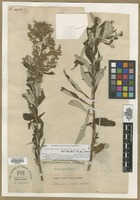
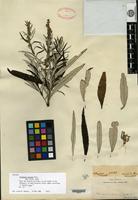
Isotype of Artemisia serrataNuttall [family ASTERACEAE ] (stored under name); Verified by Nutt., 1818
Related name
Artemisia serrata
Common name
Serrate-leaved sage, Flora of North America Vol. 19
Flora
Entry for Artemisia serrata Nuttall [family COMPOSITAE]
Herbarium
Flora of North America (FNA)
Collection
Flora of North America
Resource Type
Reference Sources
Entry From
Flora of North America, Vol 19,
Names
Artemisia serrataNuttall [family COMPOSITAE], Gen. N. Amer. Pl., 2: 142. 1818
Artemisia vulgarisLinnaeus subsp. serrata (Nuttall) H. M. Hall & Clements [family COMPOSITAE]
Treatment Author(s)
Leila M. Shultz
Information
Perennials, 50–100(–300) cm (not cespitose), pleasantly aromatic (fibrous-rooted, rhizomes horizontal, relatively short). Stems 2–5, erect, brown, mostly simple (bases woody), sparsely tomentose. Leaves cauline, bicolor (white and green); blades lanceolate, 7–15 × 1–2.5 cm, serrate (teeth ca. 2 mm), faces densely tomentose (abaxial) or glabrate (adaxial). Heads (peduncles 0 or to 2 mm) in racemiform arrays 10–15 × 5–15 cm. Involucres campanulate, 2.5–3 × 2–2.5 mm. Phyllaries lanceolate (margins hyaline), densely tomentose. Florets: pistillate 3–5; bisexual 9–10; corollas pale yellow, 1.5–2 mm, sparsely glandular. Cypselae ellipsoid, ca. 1 mm, glabrous. 2n = 36.
Phenology
jun-aug (summer), sep-nov (fall)
Altitude range
500–1800 m;
Distribution
USA Ill.USA IowaUSA Minn.USA N.Y.USA N.Dak.USA Wis.
Discussion
Artemisia serrata is closely related to A. ludoviciana and A. longifolia; it is distinguished by its prominent, serrated leaf margins. It is apparently native to the upper Mississippi Valley and naturalized in New York, presumably following introduction as a garden plant. Reports from Kansas and Missouri may be based on collections of A. ludoviciana.