JSTOR Global Plants Home
  • Home
  • Browse
  • About
  • Access
  • Account
    • Saved Items
    • Profile
  • Log in

Global Plants

Skip to Main Content
  • JSTOR Global Plants Home
  • Global Plants

    • Browse
    • About
    • Access
    • Account
      • Saved Items
      • Profile
Log in
  • Browse
  • About
  • Access
  • Account
    • Saved Items
    • Profile
Advanced Search

Compilation
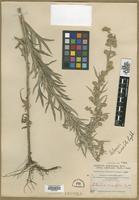
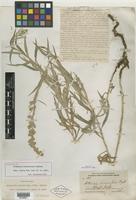
Artemisia diversifolia

2 Images see all

Type? of Artemisia ludoviciana subsp. candicans (Rydb.) D.D.Keck [family ASTERACEAE]
Holotype of Artemisia diversifolia Rydb. [family ASTERACEAE]
Previous
Next

Name

Identification
Artemisia diversifolia Rydb. [family ASTERACEAE ] (stored under name); Verified by Not on sheet,
Related name
  • Artemisia ludoviciana
  • Artemisia diversifolia
Common name
  • Armoise de l’ouest, Flora of North America Vol. 19

Flora

Entry for Artemisia ludoviciana Nuttall subsp. ludoviciana [family COMPOSITAE]
Herbarium
Flora of North America (FNA)
Collection
Flora of North America
Resource Type
Reference Sources
Entry From
Flora of North America, Vol 19,
Names
Artemisia ludoviciana Nuttall subsp. ludoviciana [family COMPOSITAE]
Artemisia brittonii Rydberg [family COMPOSITAE]
Artemisia cuneata Rydberg [family COMPOSITAE]
Artemisia diversifolia Rydberg [family COMPOSITAE]
Artemisia falcata Rydberg [family COMPOSITAE]
Artemisia gnaphaloides Nuttall [family COMPOSITAE]
Artemisia herriotii Rydberg [family COMPOSITAE]
Artemisia lindheimeriana Scheele [family COMPOSITAE]
Artemisia pabularis (A. Nelson) Rydberg [family COMPOSITAE]
Artemisia paucicephala A. Nelson [family COMPOSITAE]
Artemisia pudica Rydberg [family COMPOSITAE]
Artemisia purshiana Besser [family COMPOSITAE]
Artemisia rhizomata A. Nelson [family COMPOSITAE]
Treatment Author(s)
Leila M. Shultz
Information
Stems (gray to white) mostly simple, 30–80 cm, tomentose. Leaves gray; blades linear to narrowly elliptic, 3–11 cm, margins plane (proximalmost entire or apically lobed, lobes to 1/3 blade lengths; cauline 1.5–11 × 1–1.5 cm, entire or lobed to pinnatifid), faces densely tomentose. Heads in congested, paniculiform or racemiform arrays 5–30 × 1–4 cm. Involucres 3–4 × 2–4 mm. Florets: pistillate 5–12; bisexual 6–30; corollas 1.9–2.8 mm. 2n = 18, 36.
Phenology
jun-aug (summer), sep-nov (fall)
Altitude range
100–3000 m;
Distribution
USA Ala.USA Ariz.USA Ark.USA Calif.USA Colo.USA Conn.USA Del.USA Ga.USA IdahoUSA Ill.USA Ind.USA IowaUSA Kans.USA Ky.USA La.USA MaineUSA Md.USA Mass.USA Mich.USA Minn.USA Miss.USA Mo.USA Mont.USA Nebr.USA N.H.USA N.J.USA N.Mex.USA N.Y.USA N.C.USA N.Dak.USA OhioUSA Okla.USA Penn.USA R.I.USA S.C.USA S.Dak.USA Tenn.USA Tex.USA UtahUSA Vt.USA Va.USA Wash.USA Wis.USA Wyo.Canada Alta.Canada B.C.Canada Man.Canada N.B.Canada Ont.Canada P.E.I.Canada Que.Canada Sask.
Discussion
Subspecies ludoviciana is widespread in North America in diverse habitats. It is the most common subspecies and the most variable morphologically.

Related Materials

  • Terms and Conditions
  • Privacy Policy
  • Cookie Policy
  • Cookie Settings
  • Accessibility
  • Help
  • Contact Us
  • Facebook
  • Twitter
ITHAKA

JSTOR is part of ITHAKA, a not-for-profit organization helping the academic community use digital technologies to preserve the scholarly record and to advance research and teaching in sustainable ways.

©2000-2026 ITHAKA. All Rights Reserved. JSTOR®, the JSTOR logo, JPASS®, Aluka®, and ITHAKA® are registered trademarks of ITHAKA.

╳