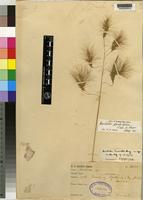
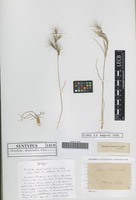
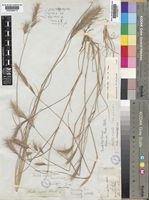
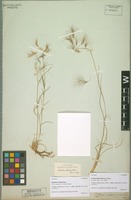
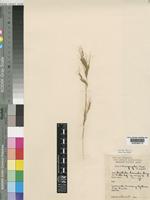
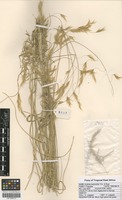
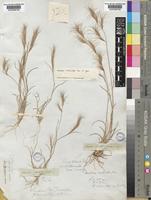
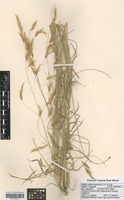
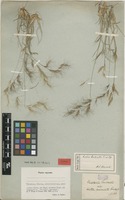
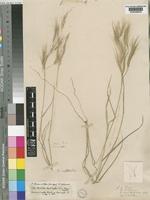
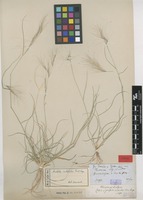
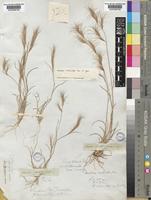
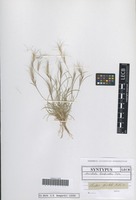
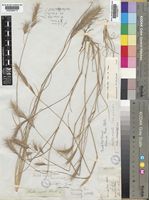
perennial, tufted, light green to glaucous, glabrous except at the mouths of the sheaths; culms slender, rather wiry, more or less compressed below, geniculately ascending or suberect, 1/2–1 1/2 ft. long, simple or scantily branched from some of the lower nodes, smooth, 2–3-noded; sheaths tight, smooth; ligule a dense line of short hairs passing into beards or a ring of long hairs at the mouths of the sheaths; blades usually very narrow, linear, acute, 1–6 in. by 3/4–1 lin., folded; convolute, curved, rigid or flat and then often twisted or curled, smooth below, scabrid above; panicle ovate to oblong, 2–6 in. long; rhachis straight or flexuous, smooth; branches solitary, distant, filiform, spreading, flexuous or straight, scaberulous, dense, spike-like from 1/4–1 1/2 in. above the base; pedicels very short; spikelets 3 1/2 lin. long; glumes keeled, the lower lanceolate, shortly mucronate, 2 lin. long, keels smooth or scabrid, the upper linear, emarginate, mucronate, 3 1/2 lin. long; valve linear, produced into a short, stout, tightly twisted beak, somewhat shorter than the upper glume, minutely scaberulous below the beak; callus less than 1/2 lin. long; awns jointed with the valve, not disarticulating, fine, 5–9 lin. long; pale, lodicules, stamens and grain as in. null