JSTOR Global Plants Home
  • Home
  • Browse
  • About
  • Access
  • Account
    • Saved Items
    • Profile
  • Log in

Global Plants

Skip to Main Content
  • JSTOR Global Plants Home
  • Global Plants

    • Browse
    • About
    • Access
    • Account
      • Saved Items
      • Profile
Log in
  • Browse
  • About
  • Access
  • Account
    • Saved Items
    • Profile
Advanced Search

Compilation
Argyrochosma jonesii

2 Images see all

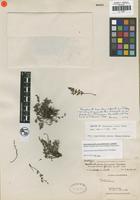
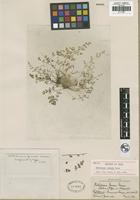
Isotype of Notholaena jonesii Maxon [family PTERIDACEAE]
Previous
Next

Name

Identification
Argyrochosma jonesii (Maxon) Windham [family PTERIDACEAE ] (stored under name); Verified by Not on Sheet, Isotype of Notholaena jonesii Maxon [family PTERIDACEAE ] Verified by Not on Sheet,
Related name
  • Argyrochosma jonesii
  • Notholaena jonesii

Flora

Entry for Argyrochosma jonesii (Maxon) Windham [family ADIANTACEAE]
Herbarium
Flora of North America (FNA)
Collection
Flora of North America
Resource Type
Reference Sources
Entry From
Flora of North America, Vol 2,
Names
Argyrochosma jonesii (Maxon) Windham [family ADIANTACEAE], Amer. Fern J., 77: 40. 1987
Notholaena jonesii Maxon [family ADIANTACEAE], Amer. Fern J., 7: 108. 1917
Cheilanthes jonesii (Maxon) Munz [family ADIANTACEAE]
Pellaea jonesii (Maxon) C. V. Morton [family ADIANTACEAE]
Treatment Author(s)
Michael D. Windham
Information
Stem scales brown to nearly black. Leaves 4--15 cm. Petiole dark brown, 0.75--1.5 mm diam. Blade ovate-lanceolate, 2--3-pinnate proximally, leathery, abaxially and adaxially glabrous; rachis rounded to slightly flattened adaxially. Pinna costae straight or nearly so, branches not arising from prominent angles. Ultimate segments not articulate, dark color of stalks continuing into segment bases abaxially; segment margins plane to slightly recurved, not concealing sporangia; veins obscure adaxially. Sporangia submarginal, borne on distal 1/2 of secondary veins, containing 64 spores. 2 n = 54, 108.
Phenology
Sporulating spring--fall
Altitude range
600--1900 m
Distribution
Mexico in Sonora.USA Ariz.USA Calif.USA Nev.USA Utah
Discussion
Argyrochosma jonesii includes two sexually reproducing cytotypes. The diploid is known from a few localities in the Sonoran and Mojave Deserts; the tetraploid is found throughout the Mojave Desert and cismontane southern California. Although subtle morphologic differences exist between these cytotypes, they are distinguished primarily by characteristics known to correlate with increases in ploidy level (such as spore size and the length of stomatal guard cells). Further investigation is necessary to determine whether the tetraploid arose through autopolyploidy or hybridization between cryptic species.

Related Materials

  • Terms and Conditions
  • Privacy Policy
  • Cookie Policy
  • Cookie Settings
  • Accessibility
  • Help
  • Contact Us
  • Facebook
  • Twitter
ITHAKA

JSTOR is part of ITHAKA, a not-for-profit organization helping the academic community use digital technologies to preserve the scholarly record and to advance research and teaching in sustainable ways.

©2000-2026 ITHAKA. All Rights Reserved. JSTOR®, the JSTOR logo, JPASS®, Aluka®, and ITHAKA® are registered trademarks of ITHAKA.

╳