JSTOR Global Plants Home
  • Home
  • Browse
  • About
  • Access
  • Account
    • Saved Items
    • Profile
  • Log in

Global Plants

Skip to Main Content
  • JSTOR Global Plants Home
  • Global Plants

    • Browse
    • About
    • Access
    • Account
      • Saved Items
      • Profile
Log in
  • Browse
  • About
  • Access
  • Account
    • Saved Items
    • Profile
Advanced Search

Compilation
Arenaria filifolia

6 Images see all

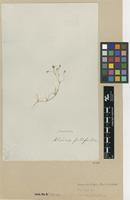
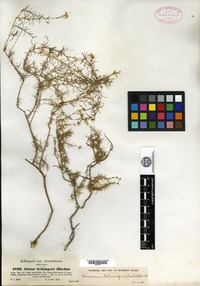
Type of Arenaria filifolia Forssk. [family CARYOPHYLLACEAE]
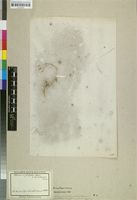
Original material of Arenaria filifolia Forssk. [family CARYOPHYLLACEAE]
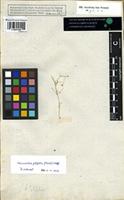
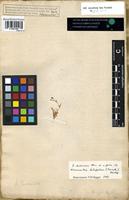
Holotype of Arenaria filifolia Forssk. [family CARYOPHYLLACEAE]
Type of Arenaria filifolia Forssk. [family CARYOPHYLLACEAE]
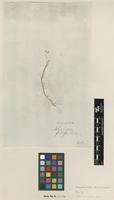
Isosyntype of Alsine schimperi Hochstetter ex A. Richard [family CARYOPHYLLACEAE]
Holotype of Arenaria fasciculata Forssk. [family CARYOPHYLLACEAE]
Previous
Next

Name

Identification
Arenaria filifolia Forssk. [family CARYOPHYLLACEAE ] Verified by Not on Sheet, Minuartia filifolia (Forssk.) Mattf. [family CARYOPHYLLACEAE ] (stored under name); Verified by D. Hillcoat, 1973
Related name
  • Spergula saginoides
  • Minuartia filifolia
  • Arenaria filifolia
  • Alsine filifolia

Flora

Entry for Minuartia filifolia (Forsk.) Mattfeld [family CARYOPHYLLACEAE]
Herbarium
Royal Botanic Gardens, Kew (K)
Collection
Flora of Tropical East Africa
Resource Type
Reference Sources
Entry From
Flora of Tropical East Africa, page 1, (1956) Author: W. B. TURRILL
Names
Minuartia filifolia (Forsk.) Mattfeld [family CARYOPHYLLACEAE], in F.R. Beih. 15: 93 (1922); Andrews, Fl. Pl. A.-E. Sudan 1: 86 (1950). Type: Arabia, on Mt. Boka [about 40° 45' N., 43° 40' E.] (C, holo., cf. Mattfeld l.c.)
Arenaria filifolia Forsk. [family CARYOPHYLLACEAE], Fl. Aegypt.-Arab. 211 (1775)
Alsine filifolia (Forsk.) Schweinf. [family ], in Bull. Herb. Boiss. 4, app. 2: 175 (1896)
Alsine schimperi [Hochst. ex] A. Rich. [family ], Tent. Fl. Abyss. 1, 47 (1847). Type: Ethiopia, Tigré, Mt. Kubbi near Adowa, Schimper 549 (K, iso.!)
Arenaria schimperi (A. Rich.) Oliv. [family CARYOPHYLLACEAE], in F.T.A. 1: 142 (1868); Fernald in Rhodora 21: 6 (1919)
Minuartia schimperi (A. Rich.) Chiov. [family CARYOPHYLLACEAE], in Nuovo Giorn. Bot. Ital. 26: 150 (1919)
Information
A perennial plant, subshrubby at the base, very much branched with branches that are more or less woody below and slender and herbaceous in the upper part, up to 2.5 dm. in total length, with internodes very short and shortly pubescent in the young shoots, elongating and becoming glabrous with age. Leaves opposite, especially aggregated towards the ends of the herbaceous branches or tufted on short axillary shoots, subulate-acicular but usually curved outwards, acute, somewhat widened and connate at the base, 5–10 mm. long, 0.1–0.2 mm. wide near the middle, glabrous. Inflorescences terminal on the branches, 1–6-flowered, pedicels 3–6 mm. long, glandular-pubescent. Sepals narrowly lanceolate, acuminate, 6 mm. long, 3-nerved, glabrous except slightly glandular-pubescent at base on outside. Petals about as long as sepals, white. Ovary triangular-ovoid with three styles. Capsule with 3 valves. Fig. 8.
Range
DISTR. T2
Altitude range
3670 m.
Distribution
TANGANYIKA Mbulu District Mt. Hanang, 2 Sept. 1932, B. D. Burtt 4040!
Distribution (external)
; Ethiopia
A.-E. Sudan
Somaliland
Eritrea
Notes
VARIATION. There is some variation amongst the specimens of the species from Ethiopia and neighbouring countries. The Tanganyika material appears to come within the range of this variation, though, on the whole, it has the sepals somewhat more acuminate and the capsules slightly shorter in length relative to the length of the sepals. With regard to indumentum the Tanganyika material has to be placed in var. schimperi (Hochst.) Schweinf. l.c.

Related Materials

  • Terms and Conditions
  • Privacy Policy
  • Cookie Policy
  • Cookie Settings
  • Accessibility
  • Help
  • Contact Us
  • Facebook
  • Twitter
ITHAKA

JSTOR is part of ITHAKA, a not-for-profit organization helping the academic community use digital technologies to preserve the scholarly record and to advance research and teaching in sustainable ways.

©2000-2026 ITHAKA. All Rights Reserved. JSTOR®, the JSTOR logo, JPASS®, Aluka®, and ITHAKA® are registered trademarks of ITHAKA.

╳