JSTOR Global Plants Home
  • Home
  • Browse
  • About
  • Access
  • Account
    • Saved Items
    • Profile
  • Log in

Global Plants

Skip to Main Content
  • JSTOR Global Plants Home
  • Global Plants

    • Browse
    • About
    • Access
    • Account
      • Saved Items
      • Profile
Log in
  • Browse
  • About
  • Access
  • Account
    • Saved Items
    • Profile
Advanced Search

Compilation
Arctotis venusta

6 Images see all

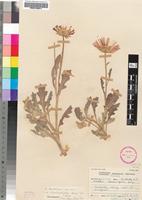
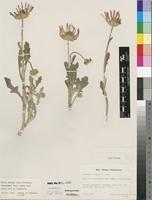
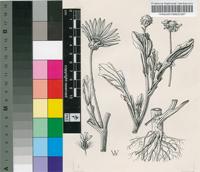
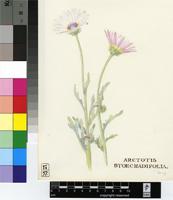
Isotype of Arctotis venusta Norl. [family ASTERACEAE]
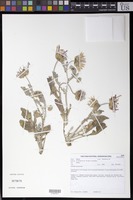
Arctotis venusta Norl. [family ASTERACEAE]
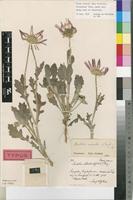
Holotype of Arctotis venusta Norl. [family ASTERACEAE]
Arctotis venusta Norl.
Previous
Next

Name

Identification
Arctotis venusta Norl. [family ASTERACEAE ]
Related name
  • Arctotis venusta
Common name
  • Blue-eyed African-daisy, Flora of North America Vol. 19

Flora

Entry for Arctotis stoechadifolia P. J. Bergius [family COMPOSITAE]
Herbarium
Flora of North America (FNA)
Collection
Flora of North America
Resource Type
Reference Sources
Entry From
Flora of North America, Vol 19,
Names
Arctotis stoechadifolia P. J. Bergius [family COMPOSITAE], Descr. Pl. Cap., 324. 1767
Arctotis grandis Thunberg [family COMPOSITAE]
Arctotis stoechadifolia var. grandis (Thunberg) Lessing [family COMPOSITAE]
Arctotis venusta Norlindh [family COMPOSITAE]
Treatment Author(s)
Alison McKenzie Mahoney
Information
Annuals or short-lived perennials, (20–)40–70(–100) cm, arachnose, pannose, or woolly. Leaves: basal and cauline, obovate, 5–20 cm × 10–45 mm, margins usually entire to undulate, sometimes dentate, lyrate, or pinnately lobed (basal and proximal cauline usually withering before flowering, their bases petioliform); distal cauline smaller (sessile, bases clasping). Peduncles (6–)10–20(–30) cm, sometimes with 1 or 2 leaves (1–3 cm). Phyllaries: outer appressed, linear to linear-lanceolate, abaxial faces arachnose (appendages 1–3 mm, blunt, woolly); inner appressed, ± lanceolate (appendages 4–6 mm, rounded to acute, ciliate). Ray florets 22–30 in 1 series; corolla laminae (17–)20–30 × 2–4 mm, abaxial faces violet, adaxial white (sometimes yellowish proximally). Cypselae obovoid, 2–3 mm, sericeous (hairs from bases) and tomentulose (on faces); pappi of 5–8, ovate to oblong, hyaline scales 0.5–4 mm (outer shorter). 2n = 18.
Phenology
jan (winter), apr-may (spring), jun-aug (summer), sep-nov (fall)
Altitude range
0–300 m;
Distribution
Africa.USA Calif.
Discussion
N. T. Norlindh (1964, 1965) treated Arctotis venusta as separate from A. stoechadifolia. In the sense of Norlindh, the latter is a rare endemic of sand dunes of the Southwestern Cape of Africa and A. venusta is common, more widespread, sometimes weedy in its native range, and cultivated elsewhere as an ornamental. Specimens from California examined for this treatment most closely resemble A. venusta in having tap roots with erect stems not rooting at nodes and phyllaries with blunt, woolly appendages less than 3 mm.
Native/Introduced
introduced;

Related Materials

  • Terms and Conditions
  • Privacy Policy
  • Cookie Policy
  • Cookie Settings
  • Accessibility
  • Help
  • Contact Us
  • Facebook
  • Twitter
ITHAKA

JSTOR is part of ITHAKA, a not-for-profit organization helping the academic community use digital technologies to preserve the scholarly record and to advance research and teaching in sustainable ways.

©2000-2026 ITHAKA. All Rights Reserved. JSTOR®, the JSTOR logo, JPASS®, Aluka®, and ITHAKA® are registered trademarks of ITHAKA.

╳