JSTOR Global Plants Home
  • Home
  • Browse
  • About
  • Access
  • Account
    • Saved Items
    • Profile
  • Log in

Global Plants

Skip to Main Content
  • JSTOR Global Plants Home
  • Global Plants

    • Browse
    • About
    • Access
    • Account
      • Saved Items
      • Profile
Log in
  • Browse
  • About
  • Access
  • Account
    • Saved Items
    • Profile
Advanced Search

Compilation
Anulocaulis leiosolenus

4 Images see all

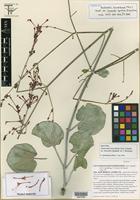
Isotype of Anulocaulis leiosolenus (Torr.) Standl. var. howardii Spellenb. & T. Wootten [family NYCTAGINACEAE]
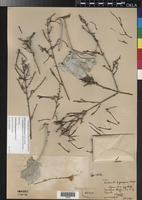
Isotype of Anulocaulis gypsogenus Waterf. [family NYCTAGINACEAE]
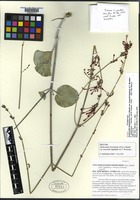
Isotype of Anulocaulis leiosolenus (Torr.) Standl. var. howardii Spellenb. & Wootten [family NYCTAGINACEAE]
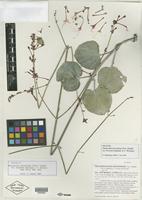
Isotype of Anulocaulis leiosolenus var. howardii Spellenb. & T. Wootten [family NYCTAGINACEAE]
Previous
Next

Name

Identification
Isotype of Anulocaulis leiosolenus Not on sheet [family NYCTAGINACEAE ] (stored under name); Verified by T. A. Zanoni,
Related name
  • Anulocaulis leiosolenus

Flora

Entry for Anulocaulis leiosolenus (Torrey) Standley [family NYCTAGINACEAE]
Herbarium
Flora of North America (FNA)
Collection
Flora of North America
Resource Type
Reference Sources
Entry From
Flora of North America, Vol 4,
Names
Anulocaulis leiosolenus (Torrey) Standley [family NYCTAGINACEAE], Contr. U.S. Natl. Herb., 12: 375. 1909
Boerhavia leiosolena Torrey [family NYCTAGINACEAE], in W. H. Emory, Rep. U.S. Mex. Bound., 2(1): 172. 1859 (as Boerhaavia)
Treatment Author(s)
Richard W. Spellenberg
Information
Herbs, stout perennial. Stems 0.5–1.5 m. Leaves: 1–3 pairs near base; petiole 3–7 cm; blade broadly ovate to almost round, 5–15 × 4–19 cm, base cordate, rarely rounded, apex rounded or broadly obtuse, adaxial surface dull green to pale green, abaxial surface grayish green, often very pale, both surfaces glabrous or sparsely villous with fine hairs with pale brown or blackish pustulate bases. Flowers borne singly or in ill-defined clusters of 2–5 on branches of inflorescence; perianth 25–35 mm, tube greenish bronze, limbs white, pink, or rose-pink, abruptly flared from tube, glabrous or minutely pubescent externally at edge (pubescence most easily seen at tip of mature bud); stamens 3, exserted 25–40 mm. Fruits biturbinate, 4.2–8 × 2.6–4.6 mm, secreting mucilage when wetted; ribs 10, narrow, undulate; equatorial flange well developed, sinuate.
Distribution
sw North America.
Discussion
Anulocaulis leiosolenus occurs as isolated, islandlike populations that are homogeneous within but differ slightly between populations. The turbinate fruits with prominent ribs and equatorial flange ridge, and the long-tubular perianths, are unifying features. Pubescence, when present, is inconspicuous on the perianth, and is best seen on tips of mature buds.

Related Materials

  • Terms and Conditions
  • Privacy Policy
  • Cookie Policy
  • Cookie Settings
  • Accessibility
  • Help
  • Contact Us
  • Facebook
  • Twitter
ITHAKA

JSTOR is part of ITHAKA, a not-for-profit organization helping the academic community use digital technologies to preserve the scholarly record and to advance research and teaching in sustainable ways.

©2000-2026 ITHAKA. All Rights Reserved. JSTOR®, the JSTOR logo, JPASS®, Aluka®, and ITHAKA® are registered trademarks of ITHAKA.

╳