

Compilation
Anthospermum spicatum
1 Images see all
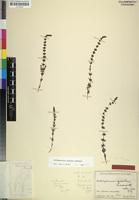
Name
Identification
Anthospermum spicatum Suess. [family RUBIACEAE ] Verified by Suessenguth, Anthospermum pumilum Sond. [family RUBIACEAE ] (stored under name); Verified by C. Puff,
Related name
- Anthospermum pumilum
- Anthospermum spicatum
Flora
Entry for Anthospermum rigidum subsp. pumilum Sond. Puff [family RUBIACEAE]
Herbarium
Royal Botanic Gardens, Kew (K)
Collection
Flora Zambesiaca
Resource Type
Reference Sources
Entry From
FZ, Vol 5, Part 1, (1989) Author: B. Verdcourt
Names
Anthospermum pumilum Sond. [family RUBIACEAE], in Harv. & Sond., F.C. 3: 31 (1865). Type from S. Africa.
Anthospermum humile N.E. Br. [family RUBIACEAE], in Kew Bull. 1895: 145 (1895). Type from S. Africa.
Anthospermum ericoideum K. Krause [family RUBIACEAE], in Engl., Bot. Jahrb. 39: 570 (1907).—Engler, Pflanzenw. Afr. 1: 574, fig. 508 (1910).—Launert & Roessler in Merxm. Prodr. Fl. SW. Afr. 115: 8 (1966). Type from SW. Africa/Namibia.
Anthospermum pumilum var. pilosum Phillips [family RUBIACEAE], in Ann. S. Afr. Mus. 16: 112 (1917). Type from Lesotho.
Anthospermum spicatum Suesseng. [family RUBIACEAE], in Trans. Rhod. Sci. Assoc. 43: 55 (1951). Type: Zimbabwe, Marondera, Dehn 547 (M, holotype).
Anthospermum rigidum subsp. pumilum Sond. Puff [family RUBIACEAE], stat nov.
Information
Non-dioecious (hermaphrodite, hermaphrodite + female, female, occasionally male or hermaphrodite + male) subshrub with an often massive, ± rosette-like woody base. Stems numerous, mostly unbranched, (5)8–20(30) cm. long, papillate to very shortly hairy and mostly ± densely leafy above. Leaves decussate, pseudo-verticillate; blades (4)6–12(22) x (0.5)0.8–1.5(2) mm., linear, linear-(ob-)lanceolate or narrowly lanceolate, ± membranous; flat to somewhat revolute margins mostly papillate, midrib below often reddish-brown and prominent; petioles subobsolete; stipular sheath with 1 (rarely 3) small seta(e). Flowers subsessile, in clusters of 6–2 (occasionally more) at nodes; corolla 4-merous, greenish to yellowish, often papillate near tip. Hermaphrodite, male: tube (0.5)0.7–1.4(1.7) mm. long, narrowly funnel-shaped, lobes 1.2–1.9(2.5) x 0.3–0.7 mm.; anthers 1–1.8(2) mm. long; hermaphrodite: stigmas often shorter than in female; ovary 0.5–0.9 x 0.3–0.8 mm., with 4 ± indistinct calyx lobes. Female: tube 0.2–0.5 mm. long, lobes 0.2–0.5 x 0.1–0.2 mm.; style 0–0.5 mm. long; stigmas 2.4–9.8 mm. long; ovary as in hermaphrodite. Fruit reddish-brown, shiny; mericarps (1.5)1.8–2.4 x 1–1.5 mm., elliptic to obovate, mostly ± glabrous, often with 2 ± broadly triangular to rounded calyx lobes 0.1–0.3 x 0.3–0.4 mm.
Habitat
Usually in (rocky) grassland or open woodland
Altitude range
c. 1050–1850 m.
1850
1050
Distribution
Zimbabwe S Bikita, fl. & fr. 20.x.1930, Fries, Norlindh & Weimarck 2122 (BM; K; MO; PRE; SRGH).Zimbabwe E Mutare Distr., Penhalonga, fl. & fr. 2.xi.1956, Robinson 1840 (K; MO; SRGH).Zimbabwe C Garch Farm, Harare South, fr. 16.i.1964, Strang 2324 (SRGH).Mozambique T Angónia, around Ulongue, fl. & fr. Stefanesco & Nyongani 270 (LMA).Zimbabwe W Matobo, Farm Besna Kobila, fl. & fr. xi.1955, Miller 3118 (LISC; PRE; SRGH).Zambia S Mazabuka Distr., Kalomo, fr. 1.i.1958, Robinson 2559 (K; M; SRGH).Botswana SE c. 14 km. S. of Ramotswa (Ramoutsa), fr. 19.i.1960, Leach & Noel 215 (K; LISC; SRGH).
Distribution (external)
S. Tanzania
Angola
SW. Africa/Namibia
S. Africa
Notes
Subsp. rigidum is confined to the drier parts of S. Africa.