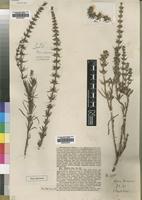
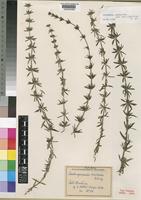
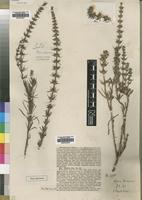
Anthospermum randiiS.Moore [family RUBIACEAE ] (stored under name);
Related name
Anthospermum erectum
Anthospermum ternatum
Anthospermum randii
Flora
Entry for ANTHOSPERMUM randii S. Moore [family RUBIACEAE]
Herbarium
Royal Botanic Gardens, Kew (K)
Collection
Flora of Tropical East Africa
Resource Type
Reference Sources
Entry From
Flora of Tropical East Africa, page 1, (1976) Author: B. VERDCOURT
Names
ANTHOSPERMUM randiiS. Moore [family RUBIACEAE], in J.B. 40: 253 (1902). Type: Rhodesia, Salisbury, Rand 475 (BM, holo.!)
Information
Annual or shrubby herb 0.7–2 m. tall; stems mostly sparsely branched, at first densely covered with white spreading hairs but finally glabrescent and with a somewhat peeling epidermis. Leaves in whorls of 3–4 or at least some leaves opposite and also with short undeveloped axillary leafy shoots giving a verticillate appearance; blades linear-lanceolate to linear-oblong, 1–3.5 (–4.7) cm. long, (1–)2.5–3(–7) mm. wide, acute or subacute at the apex, narrowed to the base, revolute, ± discolorous, pubescent or scabrid above and more densely so beneath, particularly on the main nerves which are not markedly whitish; petioles obsolete; stipules with mostly 1 seta 3–5 mm. long from a base 0.5–1 mm. long. Flowers in ± sessile axillary several-flowered clusters, hermaphrodite or unisexual and monoecious or dioecious, 4-merous (hermaphrodite ) or 5-merous (♀); pedicels 0–0.8 mm. long. Male flowers: calyx-tube 0.8–1 mm. long, the lobes minute; corolla yellow or yellowish green, pubescent outside; tube 1.5–3 mm. long; lobes elliptic, 2.6 mm. long, 1 mm. wide; filaments exserted 2–2.5 mm.; rudimentary styles 0.5 mm. long, almost free. Female flowers with corolla-tube 2.3 mm. long, lobes 1.5 mm. long; style 4.7–15 mm. long, joined and glabrous for 0.7–1.5 mm., the branches papillose. Fruit glabrous or pubescent, the cocci 2–3 mm. long, 1–1.2 mm. wide, not crowned with the calyx-limb.
Range
DISTR. T4, 5
Altitude range
1650–2400 m.
Distribution
TANZANIA Mpanda District below Kungwe Mt., 6 Sept. 1959, Harley 9529!TANZANIA Ufipa District Mbisi Forest, 13 Mar. 1957, Richards 8666!TANZANIA Kondoa District Kolo, 2 Feb. 1928, B. D. Burtt 1303!
Distribution (external)
Zaire
Zambia
Rhodesia
Angola
Notes
I at first considered this should be united with A. rosmarinus, the two being kept varietally distinct; Richards 8666 I had referred to A. rosmarinus but I now believe it is merely a large-leaved A. randii. Further material of A. rosmarinus is needed.