JSTOR Global Plants Home
  • Home
  • Browse
  • About
  • Access
  • Account
    • Saved Items
    • Profile
  • Log in

Global Plants

Skip to Main Content
  • JSTOR Global Plants Home
  • Global Plants

    • Browse
    • About
    • Access
    • Account
      • Saved Items
      • Profile
Log in
  • Browse
  • About
  • Access
  • Account
    • Saved Items
    • Profile
Advanced Search

Compilation
Anthospermum erectum

2 Images see all

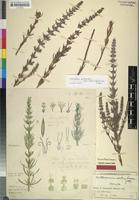
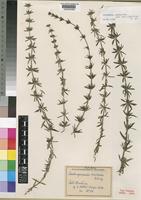
Holotype of Anthospermum erectum Suess. [family RUBIACEAE]
Anthospermum randii S.Moore [family RUBIACEAE]
Previous
Next

Name

Identification
Anthospermum randii S.Moore [family RUBIACEAE ] (stored under name); Anthospermum ternatum Hiern [family RUBIACEAE ] Verified by Puff, C., Anthospermum erectum Suess. [family RUBIACEAE ]
Related name
  • Anthospermum erectum
  • Anthospermum ternatum
  • Anthospermum randii

Flora

Entry for Anthospermum ternatum subsp. randii S. Moore Puff [family RUBIACEAE]
Herbarium
Royal Botanic Gardens, Kew (K)
Collection
Flora Zambesiaca
Resource Type
Reference Sources
Entry From
FZ, Vol 5, Part 1, (1989) Author: B. Verdcourt
Names
Anthospermum ternatum subsp. randii S. Moore Puff [family RUBIACEAE], in Pl. Syst. Evol., Suppl. 3: 285 (1986). TAB. 34, fig. B. Type: Zimbabwe, Harare, Rand 475 (BM, holotype).
Anthospermum randii S. Moore [family RUBIACEAE], in Journ. Bot., Lond. 40: 253 (1902). Type as above.
Anthospermum erectum Suesseng. [family RUBIACEAE], in Trans. Rhod. Sci. Assoc. 43: 54 (1951). Type: Zimbabwe, Marondera, 18.iii.1941, Dehn 55 (M, holotype).
Information
Plant often more branched than in subsp. ternatum and not uncommonly straggling; stems to 150 cm. long. Leaves in whorls of 3, decussate or occasionally in whorls of 4; blades variously hairy but most commonly with short hairs above and longer hairs on midrib below, less often subglabrous (leaves then larger and broader than in subsp. ternatum); largest leaves with petioles to 3 mm. long.
Habitat
Habitats as for subsp. ternatum
Altitude range
c. 950–2100 m.
2100
950
Distribution
Malawi C Dedza Distr., Chongoni Forest Reserve, fr. 16.v.1969, Salubeni 1339 (MAL; SRGH).Zimbabwe S Masvingo Distr., Kyle National Park, fr. 21.v.1971, Grosvenor 646 (SRGH).Zimbabwe E c. 6 km. from Inyanga village on Troutbeck road, fl. & fr. 26.iv.1967, Rushworth 737 (MO; SRGH).Zimbabwe C c. 12 km. S. of Gweru, fl. 25.ii.1967, Biegel 948 (K; MO; SRGH).Zimbabwe W Bulawayo, fl. & fr. iv.1911, Rogers 13681(BOL; J; PRE).Zambia S c. 8 km. E. of Choma, fl. & fr. 28.iii.1955, Robinson 1215 (K, SRGH).Malawi N Mzimba Distr., Hora Mt., fl. & fr. 30.xii.1978, Puff 781230–1/1 (BR; J; W; WU).Zimbabwe N Mazoe Distr., Umvukwes, Horseshoe Mine, fl. & fr. 16.iv.1960, Leach & Brunton 9859 (K; SRGH).Zambia C Lusaka Distr., Livingstone-Lusaka Road, fr. 29.iii.1961, Richards 14907 (K).
Distribution (external)
Angola (and Tanzania?)
Notes
A ternatum is very variable. The two subspecies are easily separable in Zambia and N. Malawi but specimens from elsewhere may be difficult to place.Especially in E. Zimbabwe, the delimition of subsp. randi and A. whyteanum may be problematic.

Related Materials

  • Terms and Conditions
  • Privacy Policy
  • Cookie Policy
  • Cookie Settings
  • Accessibility
  • Help
  • Contact Us
  • Facebook
  • Twitter
ITHAKA

JSTOR is part of ITHAKA, a not-for-profit organization helping the academic community use digital technologies to preserve the scholarly record and to advance research and teaching in sustainable ways.

©2000-2026 ITHAKA. All Rights Reserved. JSTOR®, the JSTOR logo, JPASS®, Aluka®, and ITHAKA® are registered trademarks of ITHAKA.

╳