

Compilation
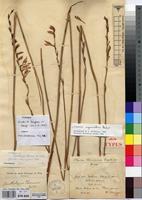
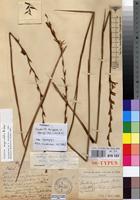
Antholyza thonneri
2 Images see all
Name
Identification
Antholyza thonneri De Wild. [family IRIDACEAE ] Verified by Not on sheet, Gladiolus unguiculatus Baker [family IRIDACEAE ] (stored under name); Verified by Goldblatt P., 1994
Related name
- Antholyza thonneri
- Gladiolus unguiculatus
Flora
Entry for GLADIOLUS unguiculatus Baker [family IRIDACEAE]
Herbarium
Royal Botanic Gardens, Kew (K)
Collection
Flora of Tropical East Africa
Resource Type
Reference Sources
Entry From
Flora of Tropical East Africa, page 1, (1996) Author: Peter Goldblatt
Names
GLADIOLUS unguiculatus Baker [family IRIDACEAE], in J.L.S. 16: 178 (1877) & in F.T.A. 7: 372 (1898); Mildbr. in E.J. 52: 232 (1923); Hepper, F.W.T.A., ed. 2, 3: 144 (1968); G.J. Lewis et al. in Journ. S. Afr. Bot., Suppl. 10: 292 (1972); Wickens, Fl. Jebel Marra: 158 (1976); Goldblatt in F.Z. 12(4): 76 (1993) & Gladiolus Trop. Afr.: 119 (1996). Type: Sierra Leone, Morson (K, holo.!)
GLADIOLUS cochleatus Baker [family IRIDACEAE], in J.B. 14: 333 (1876), nom. illegit., non Sweet (1832). Type as for G. unguiculatus
GLADIOLUS brevicaulis Baker [family IRIDACEAE], in Trans. Linn. Soc., ser. 2, 1: 267 (1878). Lectotype, chosen by Goldblatt (1996): Angola, Huila, Humpata-Lopolo R., Welwitsch 1534 (BM, lecto.!, C, COI, K, LD, P, iso.!)
Antholyza labiata Pax [family IRIDACEAE], in E.J. 15: 156, t. 7/1-4 (1893); Baker in F.T.A. 7: 374 (1898). Type: Togo, Bismarckburg, Kling 209 (B, holo.!, K, photo.)
Antholyza cabrae De Wild. [family IRIDACEAE], in Ann. Mus. Congo, Bot., sér. 5, 1: 15 (1903). Type: Zaire, Mayumbe, Sanga valley, Cabra (BR, holo.!, K, photo.)
Antholyza thonneri De Wild. [family IRIDACEAE], Études Fl. Bangala et Ubangi: 208, t. 16 (1911). Lectotype, chosen by Geerinck (1972): Zaire, near Yakoma [Ubangi], Thonner 235 (BR, lecto.!)
Gladiolus thonneri (De Wild.) Vaupel [family IRIDACEAE], in Mildbr., Z.A.E. 1910-1911: 10, 67 (1922)
Gladiolus cabrae (De Wild.) N.E. Br. [family IRIDACEAE], in Trans. Roy. Soc. S. Afr. 20: 267 (1932)
Gladiolus labiatus (Pax) N.E. Br. [family IRIDACEAE], in Trans. Roy. Soc. S. Afr. 20: 267 (1932)
Gladiolus atropurpureus [family IRIDACEAE], sensu Geerinck in B.J.B.B. 42: 271 (1972), pro parte; Oberm. in Fl. Pl. Afr. 44: t. 1760 (1977); Cribb & Leedal, Mountain Fl. S. Tanz.: 177, t. 50A (1882), non Baker (1876)]
Information
Plants 30-60 cm. high. Corm 1.5-2.5(-3.5) cm. in diameter, often dark red on the outside and sometimes internally, tunics membranous and irregularly broken to fibrous and reticulate, red-brown. Foliage leaves (of the flowering stem) usually short and entirely sheathing (then hardly distinguishable from the cataphylls) or with a short blade (rarely 2 basal leaves fairly well developed and with limbs exceeding the sheaths); foliage leaves produced after flowering on separate shoots after blooming, (?1-)2-3, linear to narrowly lanceolate, ultimately 30-45 cm. long, 4-8(-12) mm. wide, the margins and midrib lightly thickened and hyaline; sheathing leaves 3-5, usually 6-9 cm. long, somewhat longer below and exceeding the internodes, shorter above and shorter than the internodes, thus imbricate below but rarely so above, sometimes the lower with blades up to 4 cm. long. Stem erect, rarely branched. spike 10-18-flowered; bracts 1-1.5 cm. long, green, the inner somewhat shorter to nearly as long as the outer. Flowers cream to light purple, the dorsal tepals flushed light to deep purple, the lower each with deep purple spear-shaped marking in the upper third, surrounded by a lighter area, sometimes with a dark spot at the base of the dorsal tepal; in profile windowed with a gap between the dorsal and upper lateral tepals; perianth-tube ± 1 cm. long, curving outward between the bracts, widening near the mouth; tepals unequal, the dorsal largest, 1.8-2(-2.4) × 1-1.2 cm., arched over the stamens and style, much narrower toward the base, the upper laterals smaller, joined to the lower 3 for 3-5 mm., directed forward, curving outward toward the apices, the lower 3 tepals smallest, usually united for 1-2 mm., horizontal or directed downward distally, in profile usually exceeding the dorsal, 1-1.2 cm. long, narrowed below into claws, the limbs abruptly expanded. Filaments 1-1.2 cm. long, exserted 4-5 mm.; anthers 6-8 mm. long. Style dividing opposite the lower half of the anthers, the branches 2-2.5 mm. long. Capsules ellipsoid-ovoid, 1.2-1.6 cm. long. Fig. 13/1-3.
Range
DISTR. T 4, 7, 8; widespread from Senegal to Sudan and south to Angola and Zimbabwe.
Altitude range
800-2200 m.
Distribution
TANZANIA Ufipa District near the Sumbawanga-Mbala [Abercorn] road, 7 Dec. 1954, Richards 3546!;TANZANIA Njombe District Njombe-Milo road, 28 Jan. 1961, Richards 14030!;TANZANIA Songea District 9.5 km. W. of Songea, Milne-Redhead & Taylor 8054!
Notes
Distinctive in lacking foliage leaves on the flowering stem, and this combined with an erect spike of small flowers, distinctively windowed in profile, make the SPECIES easy to recognize. The flowering stem bears (2-)3, fairly short, non-overlapping sheathing leaves and true foliage leaves are produced from separate shoots on the same corm toward the end of the flowering cycle. Often confused with G. atropurpureus which has flowers of a similar size and colouring and usually lacks foliage leaves on the flowering stem. spikes of G. atropurpureus are always inclined and the flowers have broader tepals and are not windowed in profile. The corms of G. atropurpureus also differ in their small size and coarsely netted tunics, often thickened below into claw-like ridges and are quite unlike the rather large corms of G. unguiculatus with their reddish, membranous to finely fibrous tunics.Plants from the southern part of the range (Botswana, W. Zimbabwe and South Africa, Northern and Northwest Provinces) appear to differ significantly from typical G. unguiculatus. They have smaller corms, the lower leaves consistently have a short blade and they do not produce foliage leaves from separate shoots. These are now considered to be a separate SPECIES, G. oatesii Rolfe.