

Compilation
Antholyza pubescens
2 Images see all
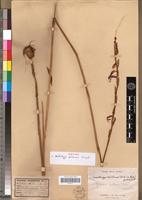
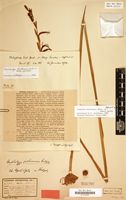
Name
Identification
Antholyza pubescens Vaupel [family IRIDACEAE ] Verified by Goldblatt, P., Gladiolus huillensis (Welw. ex Baker) Goldblatt [family IRIDACEAE ] (stored under name); Verified by Not on sheet.,
Related name
- Antholyza pubescens
- Gladiolus huillensis
Flora
Entry for Gladiolus huillensis Welw. ex Baker Goldblatt [family IRIDACEAE]
Herbarium
Royal Botanic Gardens, Kew (K)
Collection
Flora Zambesiaca
Resource Type
Reference Sources
Entry From
FZ, Vol 12, Part 4, (1993) Author: P. Goldblatt
Names
Gladiolus huillensis Welw. ex Baker Goldblatt [family IRIDACEAE], in Bull. Mus. Natl. Hist. Nat., B, Adansonia 11: 426 (1989). TAB. 28 fig. B. Type from Angola.
Antholyza huillensis Welw. ex Baker [family IRIDACEAE], in Trans. Linn. Soc. London, ser. 2, Bot. 1: 270 (1878); Handb. Irid.: 392 (1892); in F.T.A. 7: 374 (1898). Type as above.
Gladiolus subulatus Baker [family IRIDACEAE], in F.T.A. 7: 577 (1898). Type from Angola.
Antholyza degasparisiana Buscal. & Muschl. [family IRIDACEAE], in Bot. Jahrb. Syst. 49: 463 (1913). Type: Zambia, Kabwe (Broken Hill), date unknown, Aosta 157 (location of the type unknown).
Antholyza pubescens Vaupel [family IRIDACEAE], in Notizbl. Bot. Gart. Berlin-Dahlem 7, number 68: 31 (1920). Type: Zambia, ?Nyeneshi R. (“N’Yengeshi Spruit”), 28.xii.1907, Kassner (B, holotype; BM; HBG; K; P).
Petamenes huillensis Welw. N.E. Br. [family IRIDACEAE], in Trans. Roy. Soc. S. Africa 20: 276 (1932).
Petamenes degasparisiana Buscal. & Muschl. N.E. Br. [family IRIDACEAE], in Trans. Roy. Soc. S. Africa 20: 277 (1932). Type as for Antholyza degasparisiana.
Petamenes vaginifer Milne-Redhead [family IRIDACEAE], in Hook. Icon. Pl. 35: t. 3478 (1950). Type: Zambia, Mwinilunga Distr., E of Dobeka bridge, 5.xi.1937, Milne-Redheaad 3111 (K, lectotype, designated by Goldblatt & de Vos, 1989; BR; K).
Oenostachys vaginifer Milne-Redhead Goldblatt [family IRIDACEAE], in J. S. African Bot. 37: 443 (1971). — Geerinck in Bull. Soc. Roy. Bot. Belgique 105: 7 (1972). Type as for Petamenes vaginifer.
Oenostachys huillensis Welw. ex Baker Goldblatt [family IRIDACEAE], in J. S. African Bot. 37: 443 (1971). Type from Angola.
Information
Plants 30–100 cm high. Corms 16–20 mm in diameter; tunics firmly membranous to papery, fragmenting irregularly into mostly vertical strips. Leaves 3–5 on flowering stem, short and sheathing for most of their length, obscurely to obviously white pubescent, imbricate, usually at least 2 with short blades to 8 cm long; blades more or less linear, the margins and midrib thickened (well developed foliage leaves which are produced from separate shoots after flowering are not known and are probably not produced). Stem unbranched, sheathed except for a short distance below the spike, often with a short membranous sheathing leaf inserted on the upper third of the stem just above the uppermost sheathing leaf. Spike 6–14(20)-flowered; bracts green below, dry and light-brown above, 13–20(25) mm long, sometimes sparsely pubescent above, the inner about as long as or only slightly shorter than the outer. Flowers bright-red, often marked with yellow on the lower tepals and in the throat; perianth tube slender below and abruptly expanded into a cylindric upper part, the lower part 11–16 mm long and c. 1 mm in diameter, exserted from the bracts, the upper part 10–12 mm long and c. 3 mm in diameter, ascending to horizontal; tepals unequal, the uppermost c. 15 × 15 mm, spathulate, larger than the others and extending horizontally over the stamens, the upper lateral tepals deltoid, 5–6 mm long, joined to the uppermost for c. 3 mm, the lower 3 tepals lanceolate and directed forwards, the lower lateral tepals c. 6 mm long, reaching the apices of the upper lateral tepals, the lowermost tepal shorter than the rest, c. 3 mm long. Filaments c. 20 mm long, reaching to about the middle of the uppermost tepal; anthers c. 7 mm long, reaching nearly to the apex of the uppermost tepal or barely exceeding it. Style dividing opposite the upper half of the anthers, style branches 3–3.5 mm long, ultimately reaching the anther apices. Capsules 10–16 mm long, broadly ovoid.
Habitat
In light woodland.
Range
Evidently fairly rare in central and northwestern Zambia
Distribution
Zambia B Kataba, 12.xii.1960, Fanshawe 5966 (K; NDO; SRGH).Zambia C Mumbwa Distr., Kafue National Park, Ngoma, 23.xii.1964, Mitchell 25/87 (K; LISC).
Distribution (external)
western Angola
S Zaire
Notes
Flowering in November and December, early in the season, before the leaf canopy is closed and the undergrowth thick and tall.G.huillensis is distinguished by its leaves with short to vestigial blades and sparsely pubescent sheaths, together with the bright-red perianth, and the unusual form of the flowers. The upper tepal is extended horizontally much exceeding the others, the lateral tepals are only about half as long as the uppermost, and the 3 lower tepals are vestigial, only 3–6 mm long.