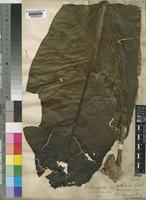
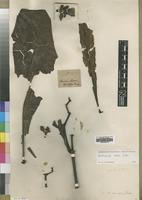
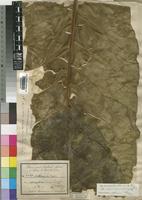
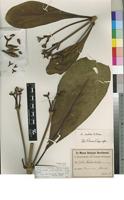
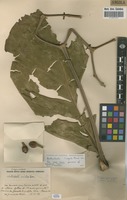
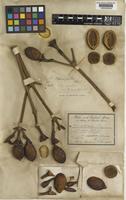
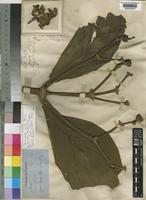
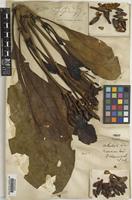
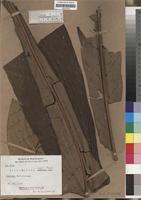
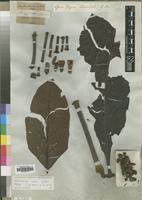
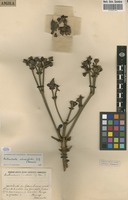
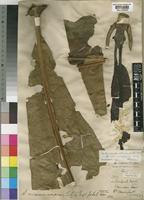
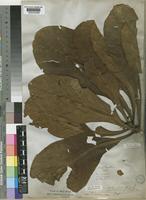
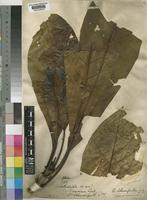
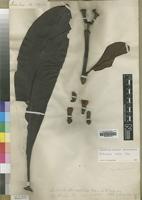
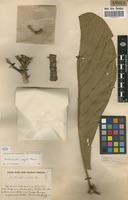
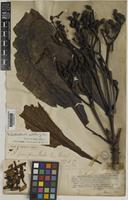
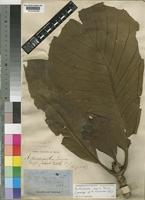
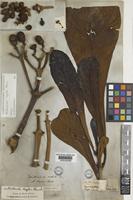
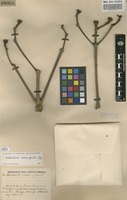
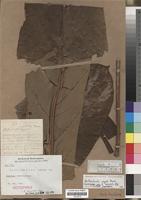
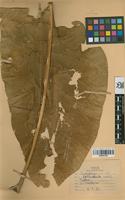
Tree 5–18 m. high, with smooth light-grey bark, sparsely branched at the top with a spreading crown; spines in pairs on the branchlets, arising well above the leaf-base, permanent on the stems of old trees and becoming woody. Leaves normally sessile, rarely shortly petiolate with petiole up to 2.5 cm. long; lamina coriaceous, generally obovate, sometimes elongate-obovate or oblanceolate, 15–50 cm. long, 8–24 cm. wide (the upper leaves smallest), rounded to broadly rounded at the apex, cuneate or narrowly cuneate, auriculate at the base; lateral nerves 11–15, prominent beneath; tertiary nerves not or rarely visible. Inflorescence shorter than the subtending leaves, 20–24(–40) cm. long; primary peduncle 7–20(–26) cm. long, secondary 3–6(–8) cm. long; pedicels very short and stout; bracts leathery, triangular, acute. Outer calyx-lobes leathery, orbicular or subquadrate, 1–1.2 cm. long, about 1 cm. broad, rounded or emarginate; inner lobes slightly longer and broader, overlapping each other, up to 1.5 cm. broad, truncate at the apex, clasping the corolla-tube. Corolla-tube 1–2 cm. long; corolla-lobes 13–15, 1–2 cm. long, oblique-oblong, often cohering at the apex and not fully opening, in bud always rounded and blunt at the apex and only a little longer than the calyx in the early stage but becoming longer with age. Anthers about 1 cm. long; staminal-tube 3–4 mm. long. Ovary ovoid, about 6 mm. long; style about 1.5 cm. long; stigma turbinate, longer than broad, about 5 mm. long. Fruits generally erect, globose or ovoid, 2.5–4 cm. long, 1.8–3 cm. in diameter, clasped by the calyx.