

Compilation
Anthericum hockii
1 Images see all
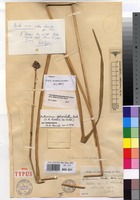
Name
Identification
Anthericum hockii De Wild. [family AGAVACEAE ] Verified by Not on sheet, Chlorophytum sphacelatum (Baker) Kativu [family AGAVACEAE ] Verified by Kativu S., 1992 Chlorophytum sphacelatum (Baker) Kativu [family AGAVACEAE ] (stored under name); Verified by P. Meerts, 2010
Related name
- Anthericum hockii
- Chlorophytum sphacelatum
Flora
Entry for CHLOROPHYTUM sphacelatum (De Wild.) Nordal var. hockii [family ANTHERICACEAE]
Herbarium
Royal Botanic Gardens, Kew (K)
Collection
Flora of Tropical East Africa
Resource Type
Reference Sources
Entry From
Flora of Tropical East Africa, page 1, (1997) Author: NORDAL (University of Oslo), SHAKKIE KATIVU (University of Zimbabwe) & AXEL D. POULSEN (University of Copenhagen)
Names
CHLOROPHYTUM sphacelatum (De Wild.) Nordal var. hockii [family ANTHERICACEAE], stat. nov. Type: Zaire, Shaba, Luembe valley, 1910, Hock (BR, holo.!)
Anthericum hockii De Wild. [family ANTHERICACEAE], in B.J.B.B. 3: 265 (1911)
Chlorophytum sphacelatum (De Wild.) Kativu subsp. hockii [family ANTHERICACEAE], in Nordic Journ. Bot. 13: 64 (1993)
Information
Plants robust, 80–165 cm. high. Peduncle flat and winged, completely glabrous. Inflorescence subglobose, dense.
Range
DISTR. T 7, 8
Altitude range
900–1750 m.
Distribution
TANZANIA Mbeya District Mbelezi–Mbozi road, 29 Mar. 1932, St. Clair-Thompson 1063!;TANZANIA Songea District ± 2.5 km. SW. of Kitai, by Nakawali R., 7 Mar. 1956, Milne-Redhead & Taylor 9046!
Distribution (external)
; Zaire
Angola
Zambia
Malawi
Notes
C. sphacelatum s.l. is a variable species complex as to size, general robustness, leaf-width and indumentum. Several attempts have been made to define more homogenous species within the complex. The variation pattern is, however, reticulate and difficult to accommodate taxonomically. We have chosen to keep three taxa at varietal level based on general robustness and indumentum characters, as they are usually easily distinguished (although transitional forms are sometimes met). Kativu & Nordal in Nordic Journ. Bot. (1993) referred the same taxa to subspecific rank. The morphological and geographical patterns as now known, indicate that the varietal level is more appropriate for the forms. On herbarium labels and sometimes also in the literature plants belonging in the C. sphacelatum and in the C. cameronii complexes have been mixed. The decisive identification characters (flower colours and stamen symmetry) may be difficult to interpret on dried material. Material from Kenya (K7), e.g. Irwin 502, Polhill & Paulo 837 & Battiscombe 771, possibly belong in the C. sphacelatum complex. More local studies on variation patterns is needed.