

Compilation
Angraecum pachyurum
1 Images see all
Name
Identification
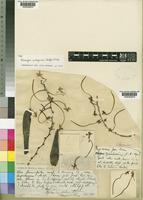
Angraecum pachyurum Rolfe [family ORCHIDACEAE ] Aerangis pachyura (Rolfe) Schltr. [family ORCHIDACEAE ] (stored under name); Verified by Stewart, J., Angraecum bilobum Lindl. [family ORCHIDACEAE ] Angraecum saundersiae Bolus [family ORCHIDACEAE ]
Related name
- Angraecum pachyurum
- Aerangis pachyura
- Angraecum saundersiae
- Angraecum bilobum
Flora
Entry for Aerangis mystacidii Rchb.f. Schltr. [family ORCHIDACEAE]
Herbarium
Royal Botanic Gardens, Kew (K)
Collection
Flora Zambesiaca
Resource Type
Reference Sources
Entry From
FZ, Vol 11, Part 2, (1998) Author: I. la Croix & P.J. Cribb
Names
Aerangis mystacidii Rchb.f. Schltr. [family ORCHIDACEAE], in Orchis 11: 17 (1917). —Schlechter in Beih. Bot. Centralbl. 36, abt. 2: 119 (1918). —Morris, Epiphyt. Orch. Malawi: 97 (1970). —Grosvenor in Excelsa 6: 78 (1976). —Williamson, Orch. S. Centr. Africa: 194 (1977). —Ball, South. African Epiphyt. Orch.: 34 (1978). —Stewart in Kew Bull. 34: 289 (1979); in F.T.E.A., Orchidaceae: 562 (1989). —Stewart et al., Wild Orch. South. Africa: 263 (1982). —la Croix et al., Malawi Orch. 1: 21 (1983). —la Croix et al., Orch. Malawi: 250 (1991). TAB. 129. Type from South Africa.
Angraecum mystacidii Rchb.f. [family ORCHIDACEAE], in Linnaea 20: 677–8 (1847); in Walpers, Ann. Bot. Syst. 1: 792 (1849). —Bolus in J. Linn. Soc., Bot. 25: 186 (1889). —T. Durand & Schinz, Consp. Fl. Afric. 5: 44 (1895). —Rolfe in F.C. 5, 3: 69 (1912).
Angraecum pachyurum Rolfe [family ORCHIDACEAE], in F.T.A. 7: 138 (1897). Type: Malawi, cult. O’Brien s.n. (K, holotype).
Aerangis mystacidioides Schltr. [family ORCHIDACEAE], in Bot. Jahrb. Syst. 53: 598 (1915). Type from Tanzania.
Aerangis pachyura Rolfe Schltr. [family ORCHIDACEAE], in Beih. Bot. Centralbl. 36, abt. 2: 119 (1918).
Information
Epiphytic herb; stem woody, up to 10 cm long, but usually much shorter; roots numerous, 2–4 mm in diameter.Leaves 2–8, distichous, 4–15(25) × 1–3(5) cm, oblanceolate to obovate, unequally or subequally 2-lobed at the apex; lamina leathery or somewhat fleshy.Inflorescences arising below the leaves, horizontal or pendent, to c. 30 cm long, 3–24-flowered.Pedicel and ovary 1–2 cm long; bracts 3–5 mm long, triangular-ovate.Flowers white, the spur tinged with pink.Tepals oblong, acute or apiculate.Dorsal sepal erect or arching over column, 7–13 × 2–6 mm; lateral sepals deflexed, 8–14 × 2.5–5 mm, somewhat oblique.Petals strongly reflexed, 6–13 × 2–4.5 mm.Lip deflexed, 7–14 × 3–4.5(8) mm, oblong or ovate-oblong, obtuse or apiculate; spur (4.5)6–8(9.5) cm long, usually thickened in the apical half, curving forwards.Column 2–4 mm long.Capsules c. 30 × 8 mm, ovoid or ellipsoid.
Habitat
Riverine and submontane evergreen forest, and in high-rainfall woodland
Altitude range
60–1800 m.
1800
60
Distribution
Zambia W exact locality unknown, G. Williamson & Odger 92 (K).Zimbabwe N Zvimba Distr., c. 100 m east of Great Dyke, 112 km NW of Harare near Mpinga, fl. 11.vii.1971, Kimberley & Pope 8 (SRGH).Malawi N Nkhata Bay Distr., Kawalazi Estate, 600 m, fl. 25.ii.1986, I.F. & E.A.S. la Croix 809 (K; MAL).Mozambique N Malema, 20.iii.1964, Torre & Paiva 11303 (LISC).Zimbabwe C Marondera Distr., Wedza Mt., 1500 m, fl. 27.iv.1961, Wild 5486 (K; SRGH).Zimbabwe E Mutare Distr., top of Chibvuku Pass, fl. 4.iv.1976, Ball 1417 (K; SRGH).Zimbabwe S Ndanga Distr., west bank of Turwi R. (Turgwe), below confluence with Dafana, 1150 m, fl. 6.v.1969, Biegel 3061 (K; SRGH).Malawi S Blantyre, 1060 m, on cypress tree in township, fl. iv.1965, Morris 141 (K).Mozambique Z Mocuba Distr., Namagoa, 200 km inland from Quelimane, 60–120 m, fl. iv.1944, Faulkner 53 (K; PRE).Mozambique T R. Shire, near Tete, fl. iv.1859, Kirk s.n. (K).Mozambique MS Mavita, Muhinga R. to Revué R., 27.iv.1948, Barbosa 1602 & 1603 (LISC).Mozambique M Namaacha, on Swaziland border, fl. iii.1931, Gomes e Sousa 441 (K).
Distribution (external)
Tanzania
Swaziland
South Africa
Notes
This species is very variable in size of both leaf and flower.This is not entirely related to growing conditions as small and large plants tend to remain like that even when grown together in cultivation.