JSTOR Global Plants Home
  • Home
  • Browse
  • About
  • Access
  • Account
    • Saved Items
    • Profile
  • Log in

Global Plants

Skip to Main Content
  • JSTOR Global Plants Home
  • Global Plants

    • Browse
    • About
    • Access
    • Account
      • Saved Items
      • Profile
Log in
  • Browse
  • About
  • Access
  • Account
    • Saved Items
    • Profile
Advanced Search

Compilation
Angraecum cultriforme

2 Images see all

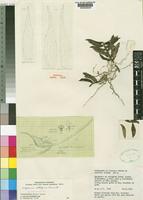
Holotype of Angraecum cultriforme Summerh. [family ORCHIDACEAE]
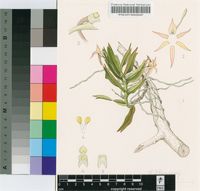
Angraecum cultriforme Summerh.
Previous
Next

Name

Identification
Angraecum cultriforme Summerh. [family ORCHIDACEAE ]
Related name
  • Angraecum cultriforme

Flora

Entry for Angraecum cultriforme Summerh. [family ORCHIDACEAE]
Herbarium
Royal Botanic Gardens, Kew (K)
Collection
Flora Zambesiaca
Resource Type
Reference Sources
Entry From
FZ, Vol 11, Part 2, (1998) Author: I. la Croix & P.J. Cribb
Names
Angraecum cultriforme Summerh. [family ORCHIDACEAE], in Kew Bull. 13: 272 (1958). —Morris, Epiphyt. Orch. Malawi: 87 (1970). —Grosvenor in Excelsa 6: 78 (1976). —Williamson, Orch. S. Centr. Africa: 180 (1977). —Ball, South. African Epiphyt. Orch.: 56 (1978). —Stewart et al., Wild Orch. South. Africa: 257 (1982). —Cribb in F.T.E.A., Orchidaceae: 498 (1989). —la Croix et al., Orch. Malawi: 239 (1991). —Stewart, Orch. Kenya: 18 (1996). Type from Tanzania.
Information
Pendent epiphytic herb; stem elongated, sometimes branched, up to c. 20 cm long.Roots 1–2 mm in diameter, borne along the stem opposite leaves.Leaves several, distichous, twisted at the base so as to lie in one plane, 3–6 × 0.5–0.9 cm, ligulate, falcate, unequally and acutely 2-lobed at the apex, the longer lobe to 7 mm long, the lobes often slightly divergent, the leaves olive-green often tinged reddish or orange.Inflorescences borne along the stem, opposite leaves, arising at same place in successive years, 1–2-flowered, the second bud usually aborting.Flowers orange-straw coloured.Peduncle 15–25 mm long; pedicel c. 7 mm long; ovary 5 mm long, forming a right angle with the pedicel.Bracts c. 4 mm long.Sepals 9–21 × 2.3–3.8 mm, lanceolate, acute; petals similar but slightly shorter.Lip 8–15 × 3.3–6 mm, boat-shaped, acuminate; spur 13–26 mm long, somewhat swollen in last 7 mm.Flowers often non-resupinate, with the spur lying parallel to the dorsal sepal.Column 1.3–2 mm long.
Habitat
Riverine forest and thicket, hanging in tangles from small branches, usually low down on host plant
Altitude range
50–700 m.
700
50
Distribution
Zambia W Nchunga Falls, fl. 26.xii.1935, R.A.F. Brenan 5 (K).Zimbabwe E Mutasa Distr., Honde Valley, xii.1961, Plowes in Ball 945 (SRGH).Malawi S Mulanje Distr., Lichenya Forest Reserve, 550 m, fl. 10.i.1986, la Croix & Spurrier 779 (K).Mozambique MS Sofala Prov., Inhansato, 50 m, fl. 16.iii.1956, Gomes e Sousa 4299 (K).
Distribution (external)
Kenya
Tanzania
South Africa
Notes
This species is variable in size of flower; those of Malawi plants are at the bottom end of the size range, but the type specimen is also rather small-flowered.For a discussion of the relationship between A. cultriforme, A. stolzii and A. umbrosum, see last species.

Related Materials

  • Terms and Conditions
  • Privacy Policy
  • Cookie Policy
  • Cookie Settings
  • Accessibility
  • Help
  • Contact Us
  • Facebook
  • Twitter
ITHAKA

JSTOR is part of ITHAKA, a not-for-profit organization helping the academic community use digital technologies to preserve the scholarly record and to advance research and teaching in sustainable ways.

©2000-2026 ITHAKA. All Rights Reserved. JSTOR®, the JSTOR logo, JPASS®, Aluka®, and ITHAKA® are registered trademarks of ITHAKA.

╳