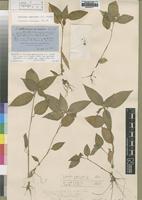
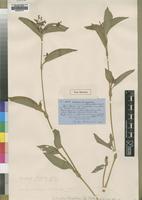
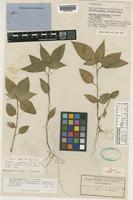
Aneilema angolenseC.B.Clarke [family COMMELINACEAE ] (stored under name);
Related name
Aneilema angolense
Aneilema pedunculosum
Flora
Entry for ANEILEMA angolense C. B. Clarke [family COMMELINACEAE]
Herbarium
Royal Botanic Gardens, Kew (K)
Collection
Flora of Tropical Africa
Resource Type
Reference Sources
Entry From
Flora of Tropical Africa, Vol 8, page 25, (1902) Author: (By C. B. Clarke.)
Names
ANEILEMA angolenseC. B. Clarke [family COMMELINACEAE]
ANEILEMA EhrenbergiiRendle [family COMMELINACEAE], in Cat. Afr. Pl. Welw. ii. 79.
Information
Sparsely hairy. Stems 2 1/3–3 ft. long, with long internodes, and branches from most axils. Leaves 3 by 1/3 in., broadly ovate, acute, narrowed at the base almost into a quasi-petiole; the uppermost large and folded. Inflorescence sessile on the upper leaves, and shorter than they, of several lax panicles (i.e. of one panicle divided at the very base); an axillary panicle is added in one example. Bracts very small; no ovate small empty bracts seen. Pedicels of the fruit 1/6 in. long. Flowers green, the lower petal yellowish (Welwitsch). Capsule 1/5 by 1/6 in., papery, shining, 2-celled, 4-seeded.
Distribution
Angola Lower Guinea Golungo Alto; in woods on the mountains of Alto Queta, 1000–2400 ft., Welwitsch, 6610!
Notes
A description of this plant is given in DC. Monogr. Phan. iii. 230, where it is supposed that it may be Lamprodithyros Ehrenbergii, Hassk., an Abyssinian plant, which probably differs, cfr. No. 27 below.