

Compilation
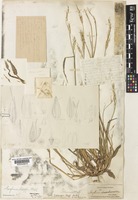
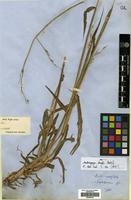
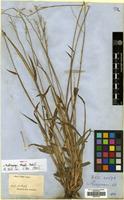
Andropogon stapfii
3 Images see all
Name
Identification
Unknown null [family UNKNOWN ] Verified by Not on sheet, Sorghum stapfii (Hook.f.) C.E.C.Fisch [family GRAMINEAE ] (stored under name); Verified by Not on sheet, Andropogon stapfii Hook.f. [family GRAMINEAE ] Verified by Not on sheet,
Related name
- Andropogon stapfii
- Sorghum stapfii
- Unknown
Flora
Entry for Sorghum arundinaceum Desv. Stapf [family GRAMINEAE]
Herbarium
Royal Botanic Gardens, Kew (K)
Collection
Flora Zambesiaca
Resource Type
Reference Sources
Entry From
FZ, Vol 10, Part 4, (2002) Author: T. A. Cope
Names
Andropogon arundinaceus Willd [family GRAMINEAE], Sp. Pl. 4: 906 (1805), non Berg. (1767).
Sorghum arundinaceum Desv. Stapf [family GRAMINEAE], in Prain, F.T.A. 9: 114 (1917). —Stent & Rattray in Proc. & Trans. Rhodesia Sci. Assoc. 32: 8 (1933). —Clayton in F.W.T.A., ed. 2, 3: 467 (1972). —Clayton & Renvoize in F.T.E.A., Gramineae: 727, fig. 168 (1982). —Lowe, Fl. Nigeria, Grasses: 277 (1989). —Setshogo in Kirkia 17: 139 (2001). TAB. 9. Type from Ghana.
Andropogon sorghum subsp. effusus Hack. Piper [family GRAMINEAE], in Proc. Biol. Soc. Wash. 28: 39 (1915).
Rhaphis arundinacea Desv. [family GRAMINEAE], Opusc. Sci. Phys. Nat.: 69 (1831).
Andropogon verticilliflorum Steud. [family GRAMINEAE], Syn. Pl. Glumac. 1: 393 (1854). Type from Réunion.
Andropogon sorghum var. effusus Hack. [family GRAMINEAE], in A. & C. de Candolle, Monogr. Phan. 6: 503 (1889), based on Andropogon arundinaceus Willd.
Andropogon stapfii Hook.f. [family GRAMINEAE], Fl. Brit. India 7: 184 (1896). Type from India.
Sorghum verticilliflorum Steud. Stapf [family GRAMINEAE], in Prain, F.T.A. 9: 114 (1917). —Sturgeon in Rhodesia Agric. J. 51: 15 (1954). —Jackson & Wiehe, Annot. Check List Nyasal. Grass.: 60 (1958). —Simon in Kirkia 8: 20, 54 (1971).
Sorghum stapfii Hook.f. C.E.C. Fisch. [family GRAMINEAE], in Gamble, Fl. Madras 3: 1735 (1934).
Sorghum pugionifolium Snowden [family GRAMINEAE], in J. Linn. Soc., Bot. 55: 240 (1955). Type from India.
Sorghum halepense [family GRAMINEAE], sensu Simon in Kirkia 8: 54 (1971), non (L.) Pers.
Sorghum sudanense [family GRAMINEAE], sensu Hall-Martin & Drummond in Kirkia 12: 159 (1980), non (Piper) Stapf.
Information
Annual, rarely short-lived perennial; culms 30–400 cm high, robust, branched; nodes mostly glabrous, sometimes pubescent; leaf sheaths glabrous; ligule a membrane, edged with a fringe of fine hairs and hairy on the back; leaf laminas variable, often large, 5–75 cm × 5–7 mm, broadly lanceolate, flat, glabrous on both surfaces, with a prominent whitish midrib. Panicle 10–60 cm long, broadly spreading; main axis angular, glabrous; primary branches divided, pubescent at the nodes; racemes 2–7-jointed; rhachis internodes and pedicels pilose. Sessile spikelet (4)7(9) mm long, lanceolate to narrowly ovate; glumes coriaceous; inferior glume dorsally compressed, narrowly ovate, 2-keeled on the margins, the keels winged, the wings not or scarcely broadened above and ending in minute teeth well below the glume apex, the latter not equally 3-toothed, white-pubescent, sometimes tomentose or fulvously pubescent, slightly depressed longitudinally on the back; superior glume glabrescent or with sparse hairs on the back; inferior floret empty, its lemma c. 5.5 mm long, lanceolate, ciliate on the margins; superior floret bisexual, its lemma c. 3 mm long, deeply lobed, ciliate on the lobes and margins, awned; awn up to 20 mm long, glabrous; palea c. 2 mm long. Pedicelled spikelets neuter, c. 6.5 mm long, linear to lanceolate; glumes chartaceous; inferior glume glabrous; superior glume slightly shorter than the inferior, glabrous; inferior lemma glabrous, with a truncate apex.
Habitat
Swampy soils, streamsides, disturbed places and old farmland
Range
Throughout Africa, extending eastwards to Australia
Altitude range
50–1400 m.
1400
50
Distribution
Botswana N North East Distr., Tati River, SE of Francistown, 980 m, 4.iii.1985, Long 12242 (E).Zambia B Lukulu Distr., Kabompo River, near Lukulu, 1964, Verboom 1184 (K).Zimbabwe N Hurungwe Distr., Mana Pools floodplain, 31.iii.1981, Dunham 73 (SRGH).Malawi N Kondowe–Karonga, vii.1896, Whyte s.n. (K).Mozambique N Ribáuè, margens do rio Mepuipui (Meperipui) na base da serra, c. 480 m, 21.i.1964, Torre & Paiva 10078 (LISC).Botswana SE Notwane Park at Notwane River, 24°38’S, 25°58’E, 1020 m, 18.iii.1978, Hansen 3387 (K).Zambia C South Luangwa National Park, Mfuwe, 26.iv.1965, B.L. Mitchell 2683 (BM; K; SRGH).Zambia E Chipata (Fort Jameson), 11.v.1963, van Rensburg 2129 (K).Zambia S Gwembe Distr., Zambezi R. c. 3 km upstream from Chirundu Bridge, 1.ii.1958, Drummond 5429 (K; PRE; SRGH).Zimbabwe W Matobo Distr., Matopos Research Station, 1370 m, 26.ii.1954, Rattray 1672 (K).Zimbabwe C Mazowe Distr., Henderson Research Station, 10.iii.1964, West 4744 (K).Zimbabwe E Mudzi Distr., Lawleys Concession, 21.ii.1954, West 3413 (K).Zimbabwe S Beitbridge Distr., Sentinel Ranch, Limpopo River, 5 km east of Limpopo–Pazhi confluence, 25.iii.1959, Drummond 5992 (K; PRE).Malawi C Nkhotakota (Nkhota Kota), 490 m, 17.vi.1970, Brummitt 11519 (K; MAL; SRGH).Malawi S Nsanje Distr., Mwanalundu Hills, 11.i.1990, Salubeni & Nachamba 5615 (MAL).Mozambique Z Lugela Distr., Namagoa, Faulkner 37 (K; PRE).Mozambique T Magoe Distr., Msusa, Zambezi Valley, 25.vii.1950, Chase 2805 (BM; K).Mozambique MS Tambara Distr., 19 km from Tambara towards Lupata, c. 170 m, 16.v.1971, Torre & Correia 18495 (LISC).Mozambique GI Chibuto, Maniquenique, Estação Experimental do C.I.C.A., 13.vi.1960, Lemos & Balsinhas 98 (K; LISC; PRE).Mozambique M Umbelúzi State Farm near Boane, 19.ii.1985, Timberlake 3386 (SRGH).
Notes
This species is the presumed wild progenitor of the grain sorghum, S. bicolor. The variability in the species-complex can be attributed to human selection of grain races and introgression with the wild species. The most obvious introgression products are generally referred to S. × drummondii (see above), but those that have progressed further from the grain sorghums by backcrossing are as likely to be assigned to S. arundinaceum as they are to the hybrid.