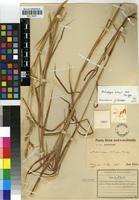
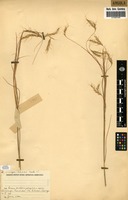
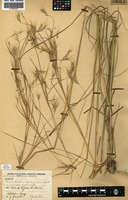
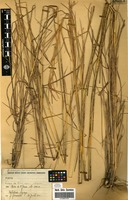
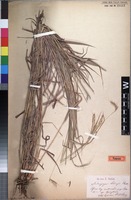
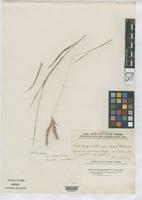
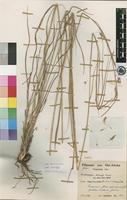
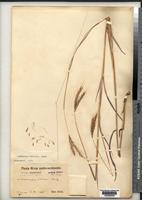
perennial; culms erect, slender, 2–4 ft. long, glabrous, terete, branched from the middle and upper nodes; branches usually simple, leafy, long, erect, flowering; leaves scattered along the culm; sheaths exceeding the internodes except the uppermost, terete, tight, glabrous, auricled at the mouth; ligules membranous, reddish, truncate, laterally produced and adnate to the auricles of the sheath, 1/2–1 lin. long; blades linear from a slightly narrower base, long tapering to a fine point, 4–8 in. by 2–3 1/2 lin., flat, rigid, glaucous, turning reddish, glabrous or hairy at the base, scaberulous; racemes 2-nate, 2–3 in. long, rather stout, strict or flexuous, rather long exserted from the uppermost sheath which bears a subsetaceous blade; joints and pedicels equal or subequal and similar, cuneate-linear, 2–2 1/2 lin. long, stout, very long and rigidly ciliate along the margins, tips hollowed, scarious, 2-lobed and unequally toothed; sessile spikelets laterally compressed, wedged in between joint and pedicel, 3–3 1/2 lin. long, glabrous, callus short, obtuse, shortly bearded, sunk in the hollow of the tip of the preceding joint; lower glume subcoriaceous to chartaceous, linear, minutely 2-toothed, keels narrow, acute, spinulously ciliate above, with a deep narrow groove (fold) between them, and with 4 nerves close to each keel; upper glume firmly membranous, boat-shaped, 3-nerved, with a terminal bristle about as long as the spikelet, keel scabrid, margins ciliate; valves equal, lower linear-oblong, obtuse, 2-nerved, ciliate; upper broadly oblong, deeply bifid, 3-sub-5-nerved, lobes lanceolate, ciliolate, awn slender, about 1 in. long, kneed just below the middle, scaberulous below the knee; pale linear, almost as long as the valve, nerveless, glabrous; anthers 1 1/2 lin. long; pedicelled spikelets ♂, dorsally compressed, linear-lanceolate, acute, 3 1/2 lin. long, purplish or reddish; lower glume herbaceous, minutely 2-toothed with an interposed bristle of about the same length, 2-keeled, keels scabrid, intracarinal nerves 7–9; upper glume lanceolate, 3-nerved, ciliolate, aristulate like the lower; valves oblong-linear, acute or mucronulate, 3-nerved; lower finely 2-keeled, keels rigidly ciliate; upper long and softly ciliate, muticous. null