

Compilation
Andropogon lasiobasis
2 Images see all
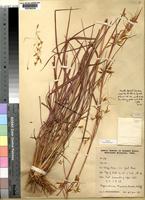
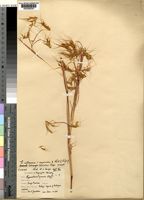
Name
Identification
Andropogon lasiobasis Pilger [family POACEAE ] Hyparrhenia nyassae (Rendle) Stapf [family POACEAE ] (stored under name);
Related name
- Hyparrhenia nyassae
- Andropogon lasiobasis
Flora
Entry for HYPARRHENIA nyassae (Rendle) Stapf [family POACEAE]
Herbarium
Royal Botanic Gardens, Kew (K)
Collection
Flora of Tropical East Africa
Resource Type
Reference Sources
Entry From
Flora of Tropical East Africa, page 451, (1982) Author: W. D. CLAYTON and S.A. RENVOIZE
Names
HYPARRHENIA nyassae (Rendle) Stapf [family POACEAE], in F.T.A.: 9: 313 (1919); Ann. list grasses Ug.: 24 (1947); R.K.G.: 60 (1958); Ann. list Nyasaland grasses: 45 (1958); I.G.U.: 36 (1960); G.T.: 108 (1965); Clayton in F.W.T.A., ed. 2, 3: 491 (1972). Type: Malawi, Buchanan 1423 (K, iso.!)
Andropogon nyassae Rendle [family POACEAE], in J.B. 31: 358 (1893)
Andropogon rufus Pilg. var. auricomus [family POACEAE], in E.J. 30:268 (1901). Type: Tanzania, Njombe District, Ukinga [Kinga] Mts., Goetze 901 (K, iso.!)
Cymbopogon chrysargyreus Stapf [family POACEAE], in Journ. de Bot., sér. 2, 2: 213 (1909). Type: Central African Republic, Kémo R., Chevalier 5366 (P, holo.!, K, iso.!)
Andropogon chrysargyreus (Stapf) A. Chev. [family POACEAE], Sudania 1: 77 (1911)
Andropogon lasiobasis Pilg. [family POACEAE], in Fries, Wiss. Ergebn. Schwed. Rhod.-Kongo-Exped. 1: 197 (1916). Type: Zambia, Luwingu, Fries 1089 (UPS, holo.!)
Cymbopogon nyassae (Rendle) Pilg. [family POACEAE], in E.J. 54: 287 (1917)
Hyparrhenia vulpina Stapf [family POACEAE], in F.T.A. 9: 310 (1919); Fl. Agrost. Congo Belge 1: 168 (1929); Ann. list Nyasaland grasses: 45 (1958). Type: Angola, Munongue, Gossweiler 3120 (K, lecto.!)
Hyparrhenia chrysargyrea (Stapf) Stapf [family POACEAE], in F.T.A. 9: 312 (1919); Fl. Agrost. Congo Belge 1: 169 (1929)
Cymbopogon vanderystii De Wild. [family POACEAE], in B.J.B.B. 6: 24 (1919). Type: Zaire, Kisantu, Vanderyst 373 (BR, holo.!)
Hyparrhenia vanderystii (De Wild.) Vanderyst [family POACEAE], in Bull. Agric. Congo Belge 11: 144 (1920)
Information
Caespitose perennial, the basal leaf-sheaths pubescent to tomentose with white hair; culms 0.5–1.5 m. high. Leaf-blades up to 45 cm. long, 2–5 mm. wide. False panicle lax, 15–45 cm. long; spatheoles linear, 3–6 cm. long, russet, the peduncles usually exserted; racemes 2–3 cm. long, 8–13-awned per pair, fulvous or greyish yellow, tardily and imperfectly deflexed; raceme-bases unequal, the upper 2–3 mm. long, terete, glabrous or sometimes sparsely pilose, the articulation with the peduncle tip usually marked by a ring of white hairs. Homogamous pairs 1 at the base of the lower raceme. Sessile spikelet 5–6 mm. long, densely pubescent with fulvous hairs; callus linear to slenderly cuneate, 0.8–1.2 mm. long, acute to very narrowly truncate; awn 2–4 cm. long, fulvously pubescent. Pedicelled spikelet muticous.
Range
DISTR. U2–4; K4, 5; T1, 2, 4, 7, 8 Cameroun and Ethiopia to South Africa; a single record in Ghana
Altitude range
930–2600 m.
Distribution
KENYA Embu, 8 May 1920, Shantz 994!KENYA Machakos District Ol Doinyo Sapuk, 26 Jan. 1964, Napper et al. 1721!KENYA N. Kavirondo District 8 km. SE. of Bungoma, 27 June 1955, Bogdan 4060!TANZANIA Iringa District Mufindi, 12 May 1968, Renvoize & Abdallah 2122!TANZANIA Njombe District 1931, Emson 127!TANZANIA Songea District Miyau, 23 May 1956, Milne-Redhead & Taylor 10293!UGANDA Mbale District Malaba [Malawa] R., Tororo, 1 Mar. 1936, Michelmore 1197!UGANDA Mengo District Buruli, 16 May 1941, A.S. Thomas 3756! & Kakoge, 24 May 1964, Tateoka 3230!
Distribution (external)
Thailand
Vietnam
Notes
H. nyassae generally has hairier racemes and a longer more pointed callus than H. rufa, but the two species cannot be distinguished with certainty if the basal sheaths are missing. It is also similar to the W. African species H. smithiana (Hook. f.) Stapf which has purple sheath hairs, and which has commonly been misidentified as “ H. chrysargyrea ”.A distinction between narrow-leaved tussocky specimens (H. nyassae) and taller specimens with leafy culms (H. vulpina) is untenable, for variation between the two is apparently quite continuous.