JSTOR Global Plants Home
  • Home
  • Browse
  • About
  • Access
  • Account
    • Saved Items
    • Profile
  • Log in

Global Plants

Skip to Main Content
  • JSTOR Global Plants Home
  • Global Plants

    • Browse
    • About
    • Access
    • Account
      • Saved Items
      • Profile
Log in
  • Browse
  • About
  • Access
  • Account
    • Saved Items
    • Profile
Advanced Search

Compilation
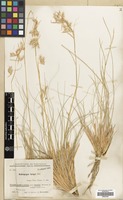
Andropogon laniger

13 Images see all

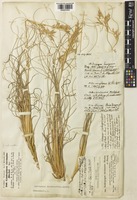
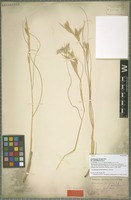
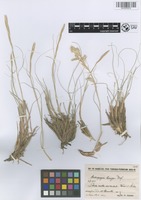
Isotype of Andropogon circinnatus Hochst. & Steud. [family POACEAE]
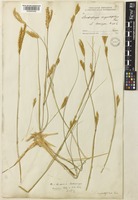
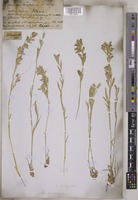
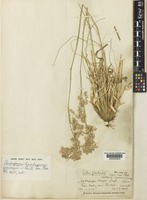
Eulaliopsis binata (Retz.) C.E.Hubb. [family POACEAE]
Isotype of Andropogon circinnatus Hochst. & Steud. [family POACEAE]
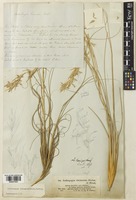
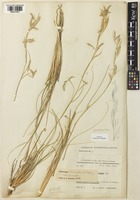
Cymbopogon jwarancusa (Jones) Schult. subsp. olivieri (Boiss.) Soenarko [family POACEAE]
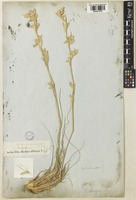
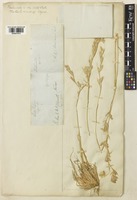
Filed as Andropogon laniger Desf. [family POACEAE]
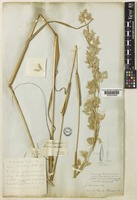
Isotype of Andropogon himalayensis Gandoger [family POACEAE]
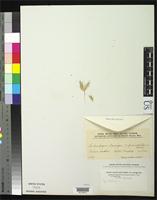
Cymbopogon jwarancusa (Jones) Schult. subsp. olivieri (Boiss.) Soenarko [family POACEAE]
Type of Andropogon laniger Desf. variety grandiflorus Hack. [family POACEAE]
Andropogon laniger Desf. [family POACEAE]
Cymbopogon jwarancusa (Jones) Schult. subsp. jwarancusa [family POACEAE]
Cymbopogon schoenanthus (L.) Spreng. subsp. schoenanthus [family POACEAE]
Filed as Andropogon laniger var. grandiflorus Hackel, E. 1889 [family POACEAE]
Filed as Cymbopogon schoenanthus (L.) Spreng. [family GRAMINEAE]
Previous
Next

Name

Identification
Andropogon laniger Not on Sheet [family POACEAE ] (stored under name); Verified by Not on sheet,
Related name
  • Andropogon laniger

Flora

Entry for CYMBOPOGON Schœnanthus Spreng. [family POACEAE]
Herbarium
Royal Botanic Gardens, Kew (K)
Collection
Flora of Tropical Africa
Resource Type
Reference Sources
Entry From
Flora of Tropical Africa, Vol 9, page 1, (1917) Author: (By O. STAPF.)
Names
CYMBOPOGON Schœnanthus Spreng. [family POACEAE], Pug. ii. 15, not of Schult. —Stapf in Kew Bulletin, 1906, 303–313, 352–353; Chiov. Gram. da Essenze, 15.
CYMBOPOGON arabicus Nees ex Steud. [family POACEAE], Syn. Pl. Glum. i. 387.
CYMBOPOGON Arriani Aitch. [family POACEAE], Cat. Punjab Pl. 174.
CYMBOPOGON circinnatus Hochst. ex Hack. [family POACEAE], in DC. Monogr. Phan. vi. 599.
Andropogon Schœnanthus Linn. [family POACEAE], Sp. Pl. ed. i. 1046, ed. ii. 1481, not of Hack, and most other authors.
Andropogon bicornis Forsk. [family POACEAE], Fl. Ægypt.-Arab. 173, not of Linn.
Andropogon laniger Desf. [family POACEAE], Fl. Atl. ii. 379 (lanigerum); Kunth, Enum. Pl. i. 493; Coss. & Dur. Expl. scient. Algérie, ii. 48; Ball in Journ. Linn. Soc. Bot. xvi. 734; Boiss. Fl. Or. v. 465; Batt. & Trab. Fl. Alger. (Monoc.) 126; Balfour, Bot. Socotra, 316; Hack. in DC. Monogr. Phan. vi. 598; Benth. in Hook. Ic. Pl. t. 1871; Schweinf. Plant. Util. Eritr. 22, and in Bull. Herb. Boiss. ii. App. ii. 93.
Andropogon Olivieri Boiss. [family POACEAE], Diagn. Pl. Or. ser. i. fasc. v. 76.
Andropogon circinnatus Hochst. ex Steud. [family POACEAE], Syn. Pl. Glum. i. 387; Franch. Sert. Somal. 69 (circinatus).
Andropogon Ariani Edgew. [family POACEAE], in Journ. Linn. Soc. vi. 208.
Andropogon Iwarancusa Hook. f. subsp. laniger [family POACEAE], Fl. Brit. Ind. vii. 203.
Gymnanthelia lanigera Anderss. [family POACEAE], in Schweinf. Beitr. Fl. Aethiop. 306 (name only).
Information
Perennial, compactly cæspitose, with numerous intravaginal innovations, 1/2–1 1/2 ft. high. Culms erect, slender, few- to 4-noded and simple below the inflorescence, terete, glabrous, very rarely with a few small hairs at the nodes. Leaf-sheaths very firm, smooth, glabrous, tight, those of the innovations and base of the culms widened at the base, very tough and long-persistent, straw-coloured, up to 5 in. long; ligules membranous to scarious, oblong, truncate, ciliate, up to 1 1/2 lin. long; blades semiterete, filiform, wiry, flexuous, very fine and often circinate upwards, rounded on the back, channelled on the face, or those of the culms somewhat flatter and shorter, up to more than 9 in. long, 1/2 lin. in diam., glabrous, finely scaberulous on the nerves below, though often smooth to the touch, pale, glaucous, evenly 7–9-nerved, the midrib showing only above as a broad white band. Spatheate panicle narrow, 3–12 in. long, few- to 7-noded, lower internodes 2–3 in. long, upper rapidly decreasing in length, slender, glabrous; lowest primary branch rarely undivided at the base, 3–2-noded and up to 6 in. long, usually forming—like the following—up to 4-rayed simple or mixed tiers; lowest subtending sheaths with foliaceous blades; rays finely filiform, 1–1 1/2 (rarely to over 2) in. long, glabrous; spathes narrowly lanceolate, subherbaceous, often tinged with pale purple, with a short blade or the upper bladeless and produced into a setaceous point, 1 1/2–1 3/4 in. long, glabrous. Spatheoles very narrow, acute or with a setaceous point 1/2–1 in. long, pale or straw-coloured; peduncles finely filiform, widened upwards, 1 1/2–2 lin. long, tips truncate. Racemes 2-nate, more or less divaricate, at length epinastically deflexed, 1/2–1 lin. long, white-villous, pale or tinged with purple, one subsessile, the other with a bare base, 1/2–1 lin. long; bases puberulous to pubescent in the fork, ciliate-bearded upwards, with minutely cupular and denticulate tips, that of the subsessile raceme as well as the adjacent pedicel stout, elliptic to elliptic-oblong in outline and convex on the back, ultimately more or less glabrescent and glossy; fertile joints filiform, slightly widened towards the oblique subcupular auricled tips, 1 1/4–1 1/2 lin. long, densely hairy to villous from the back and the angles (hairs increasing upwards to 2 lin. long); adjacent pedicels similar to the joints but more slender. Homogamous pair of spikelets 1 at the base of the sessile or of both racemes; the sessile spikelet of the lowest but one of the sessile raceme intermediate and imperfectly awned. Fertile spikelets linear-lanceolate, more or less acuminate, acute, including the callus 2 1/2–3 or even 3 1/2 lin. long, glabrous, pale green below, reddish upwards; callus short, obtuse, shortly bearded. Glumes equal, chartaceous; lower nerveless and shallowly concave between the acute scaberulous keels, minutely 2-denticulate; upper lanceolate-oblong in profile, acute, slightly curved on the back, 1-nerved, margins broadly hyaline upwards, ciliate. Lower floret reduced to a linear-oblong nerveless hyaline ciliolate valve, slightly shorter than the glumes. Upper floret hermaphrodite: valve very narrow, shortly 2-fid, cuneate-linear and chartaceous below the insertion of the awn, under 1 1/2 lin. long, lobes broadly lanceolate, ciliate; awn up to 5 lin. long, very fine, more or less kneed at and slightly twisted below the middle; column smooth. Anthers 1 lin. long. Pedicelled spikelets ♂, linear-oblong, 2–3 lin. long, glabrous, more reddish than the sessile; glumes subchartaceous with 5–9 evenly distant intracarinal nerves, the upper thinner, 3-nerved; valve of lower floret linear-oblong, sub-2-nerved, ciliolate, 2 lin. long; upper floret reduced to a ♂ flower, or its valve present as a microscopic scale.
Range
Throughout North Africa, from Morocco to Tunis, Arabia, and from Mesopotamia to the Punjab and Ladakh.
Distribution
Eritrea Nile Land Barca; Mount Schegolgol-Mantai, Schweinfurth, 40; and without precise locality, Schweinfurth, 1020.Socotra Nile Land near Tamarida, Schweinfurth, 405! hills near Galonsir and Tamarida, Balfour, 275! 379!Somaliland Nile Land without precise locality, Révoil.
Notes
Once famous for its aromatic properties. Yields an aromatic oil (camelgrass oil).

Related Materials

  • Terms and Conditions
  • Privacy Policy
  • Cookie Policy
  • Cookie Settings
  • Accessibility
  • Help
  • Contact Us
  • Facebook
  • Twitter
ITHAKA

JSTOR is part of ITHAKA, a not-for-profit organization helping the academic community use digital technologies to preserve the scholarly record and to advance research and teaching in sustainable ways.

©2000-2026 ITHAKA. All Rights Reserved. JSTOR®, the JSTOR logo, JPASS®, Aluka®, and ITHAKA® are registered trademarks of ITHAKA.

╳