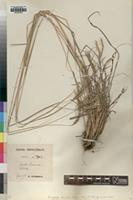
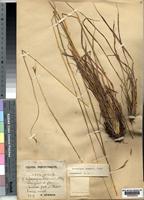
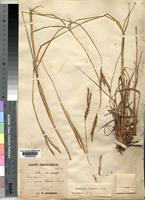
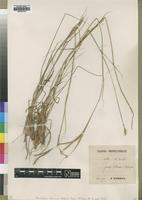
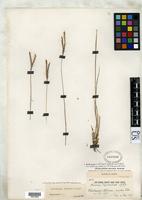
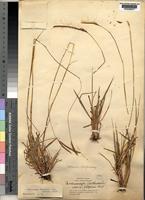
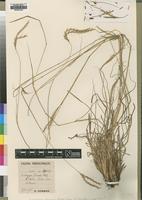
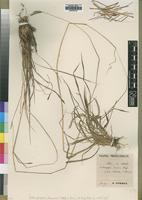
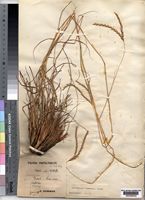
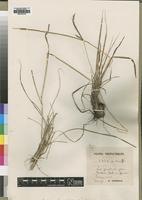
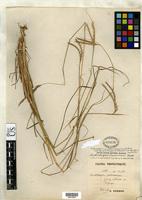
Perennial, densely tufted, 1 1/2–3 ft. high, with numerous innovations, coated at the base with long-persistent fibrous sheaths. Culms erect, very slender, simple, 2–3-noded, glabrous, smooth, internodes often long-exserted. Leaf-sheaths terete, tight, glabrous, the lowest short, persistent and usually breaking up into fibres; ligules short, rounded, membranous, 1/2– 3/4 lin. long; blades linear, somewhat attenuated towards the base, long-tapering to a fine point, up to over 6 in. by 1–2 lin., somewhat soft or at least flexuous, at length turning brown, scattered with fine white long more or less spreading hairs above in the lower part, otherwise glabrous, margins more or less spinulously scabrid, midrib slender, prominent below, lateral nerves 3–5 on each side, very fine; subtending leaf with a very narrow soon convolute sheath, and usually a filiform or setaceous blade. Peduncle filiform, slender, at length usually long-exserted, tips imperfectly articulated, usually minutely bearded. Racemes 2-nate, one sessile or subsessile, the other with a short base, slightly flexuous or straight, 1 1/2–3 in. long, slender, rather dense, olive-green, tinged with purple or brown; joints cuneate down to the middle, then linear, 2 lin. long, mostly shortly and loosely ciliate on the outer side all along, on the inner side up to the middle, outer and uppermost cilia rarely over 1 lin. long, tips obliquely and shallowly cupular and crenulate. Sessile spikelets heterogamous (except the lowest of the sessile racemes—rarely of both racemes—which is imperfect and awnless), laterally much compressed, tightly wedged in between joint and pedicel, linear-lanceolate in front view, 2 1/2–2 3/4 lin. long including the callus which is subobtuse, over 2 lin. long, and scantily bearded from the very base. Glumes equal, chartaceous, glabrous, the lower acuminate, 2-denticulate, deeply grooved between the very narrow and upwards acute and scaberulous keels, nerveless between the keels, the upper boat-shaped, subacute, 1-nerved, or with very obscure marginal nerves, ciliate. Lower floret reduced to an oblong subobtuse 2-nerved ciliolate subhyaline valve. Upper floret hermaphrodite; narrow linear-oblong, shortly 2-fid, 1 1/2 lin. long, ciliolate, 3-nerved below; awn fine, 3/4–1 in. long, bent at and twisted about the middle, more or less flexuous; valvule lanceolate-oblong, acute, over 1 lin. long, awnless. Anthers up to 1 1/2 lin. long. Pedicelled spikelets ♂, broadly lanceolate to lanceolate-oblong, acute or acuminate, 2 1/2–3 1/2 lin. long, up to 1 lin. wide, usually convex or almost flat on the back, glabrous, often dark and dull purplish; lower glume subherbaceous with numerous close nerves of which the central and the outer are per-current, keels scabrid above; upper membranous, acuminate, finely 3-nerved, ciliate; valves of both florets hyaline, oblong, slightly shorter than the glumes, of the lower 2-nerved, ciliolate, of the upper 1-nerved, eciliolate; valvule linear, 1 lin. long.