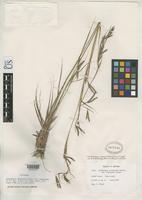
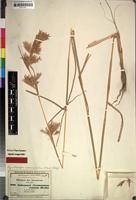
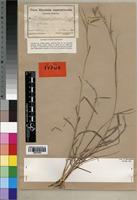
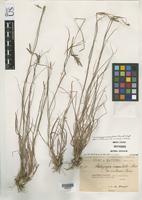
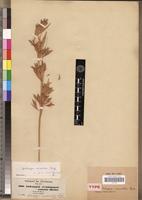
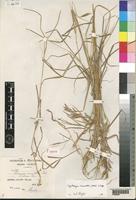
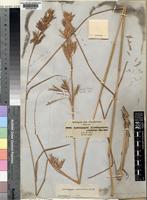
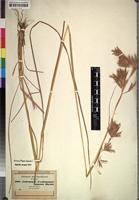
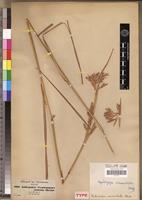
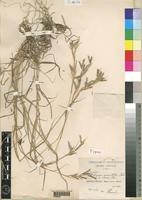
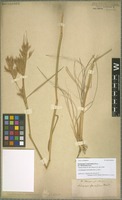
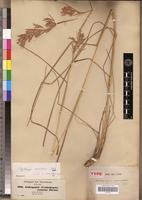
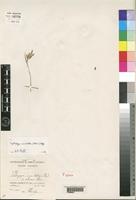
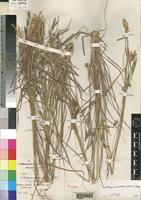
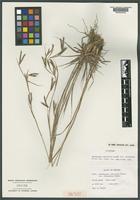
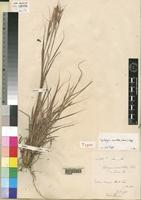
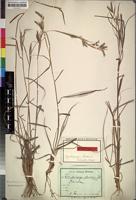
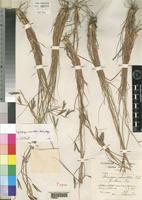
Perennial, up to 4 ft. high, with intravaginal innovations. Culms erect, terete, simple and about 5-noded below the panicle, finely pubescent below the nodes, otherwise glabrous. Leaf-sheaths firm, terete, tight, glabrous, smooth or slightly rough on the back, the basal up to 4 in. long, more or less persistent; ligules membranous, truncate, up to 1 lin. long, ciliolate; blades linear, tapering to a setaceous point, the inner of the innovations very narrow, the outer and those of the culm-leaves over 3/4 (probably over 1) ft. long, up to over 2 lin. broad, rigid, flat, dull green turning russet, glabrous, almost smooth, at least below, more or less rough along the margins, midrib very slender, primary lateral nerves 3–4, prominent above, obscure below. Spatheate panicle very narrow, interrupted below, up to 1 ft. long; internodes 5–6, lowest up to over 6 in. long, upper rapidly decreasing in length; lower leaves of the panicle more or less like those lower down on the culm, blade-bearing, upper more and more reduced, spathe-like, bladeless; primary branches usually forming up to 6-rayed fastigiate tiers; lower tiers mixed, rays very finely filiform, slightly unequal, even the compound frequently shorter than the supporting spathe or sheath; spathes very narrow, linear, acute, glabrous, those of the shortest compound rays often permanently enclosed and thin, of the longer exserted, scarious to subherbaceous, up to 1 1/2 in. long, hardly over 1 lin. wide in profile. Spatheoles very narrow, acute, scarious to submembranous, reddish, 1 1/2– 3/4 in. long; peduncles 6–3 lin. long, finely filiform, pubescent upwards. Racemes 2-nate, hardly diverging, erect, 2/3 to 1 in. long, moderately villous, reddish-brown, one subsessile, the other with a distinct bare base; bases rather stout upwards, or that of the upper raceme linear and up to 1 lin. long, minutely pubescent, their tips cupular and denticulate, the adjacent pedicel of the subsessile raceme more or less swollen and hard, 1 lin. long, glabrous on the back; fertile joints linear, 1 3/4 lin. long, pubescent on the back, very shortly ciliate below, long-ciliate towards the cupular tips (cilia up to 1 1/2 lin. long), cupule rather conspicuous, membranous, dentate; adjacent pedicels very similar. Homogamous or imperfect sessile spikelet 1 at the base of the sessile raceme, intermediate as to shape. Fertile spikelets linear in front view, more or less acuminate, 2 3/4–3 1/2 lin. long, greenish, turning straw-colour or reddish, glabrous; callus short, obtuse, shortly bearded. Glumes unequal, chartaceous; lower obscurely 2-dentate, deeply grooved below the middle with a callous gibbosity at the base, shallowly concave to flat upwards, keels acute, scabrid, intracarinal nerves 0, inflexed margins narrow; upper glume shorter, linear-lanceolate in profile, acute, hardly curved on the back, 1-nerved, ciliate. Lower floret reduced to a narrow oblong hyaline almost nerveless ciliate valve, slightly shorter than the upper glume. Upper floret hermaphrodite: valve narrow, linear, 2-fid to over one-third, 2 lin. long, subchartaceous below, lobes sublinear, ciliolate, awn slender, 5–6 lin. long, distinctly differentiated into a dark brown twisted column and a yellowish bristle. Pedicelled spikelets ♂, linear-lanceolate, acute, 3 1/2 lin. long, brownish, glabrous; glumes subequal, lower chartaceous, with scabrid keels and 7–9 very close intravaginal nerves, upper membranous, acute, 3-nerved, keeled; valve linear-oblong, almost as long as the upper glume, hyaline, ciliate, faintly 2-nerved; anthers over 1 lin. long.