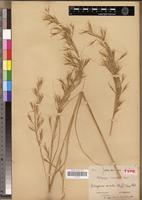
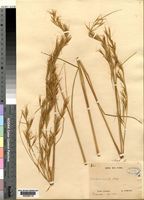
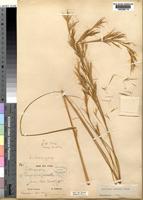
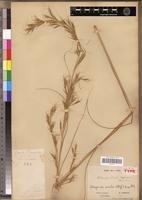
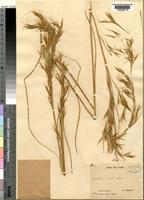
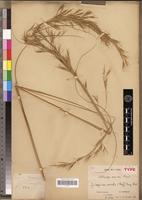
Perennial, up to 12 ft. high (Hens). Culms simple and erect, glabrous, usually pruinose or finely pubescent near the nodes, 4-many-noded (?) below the panicle. Leaf-sheaths tight, glabrous or more or less hairy upwards, sometimes finely pubescent at the base; ligules very short, rounded or truncate, ciliolate, decurrent on the sheath; blades narrowly linear from an equally wide base, long-attenuated to a setaceous point, rather firm, up to 10 in. long by 2 lin. wide, flat, loosely hirsute, particularly towards the junction with the sheath, or glabrous, scabrid along the margins, midrib rather wide on the upper side, slender below, lateral nerves fine and close. Spatheate panicle erect, compound to the second degree, more or less contracted, up to over 1 1/2 ft. long; primary internodes 6–10, lowest rarely over 5 in. long, the following at first gradually, then rapidly decreasing, the upper usually scaberulous or very finely pubescent upwards and shortly bearded at the nodes; primary tiers up to 4-rayed (the lowest branch often undivided at the base, up to over 1 ft. long and up to 7-noded), rays very unequal and except the uppermost usually all mixed, their compound rays with 3–1 (simple)-rayed secondary tiers; ultimate rays finely filiform, slightly thickened and rough towards the unilaterally bearded tips, those of the lower tiers up to 2 in., of the uppermost 3/4– 2/3 in. long; lower subtending leaves like the preceding ones with long blades, the latter rapidly decreasing and finally quite suppressed in the upper part of the panicle, uppermost spathes therefore quite spatheoloid. Spatheoles linear-lanceolate, acute, 1 in. long, subherbaceous, greenish-brown or glaucous and purplish, glabrous or very sparingly hairy; peduncles densely puberulous upwards, much shorter than and enclosed in the spatheole, on maturity 2 1/2–4 lin. long. Racemes of 2 sessile and 3 pedicelled spikelets, about 7–9 lin. long; joint and pedicels filiform, shortly ciliate on both sides, glabrous on the back, about 2–2 1/2 lin. long. Sessile spikelet linear-oblong, 2 1/2–3 lin. long including the callus, glabrous, pale to chestnut-brown and glossy below the middle, pale green above; callus almost pungent, 3/4–1 lin. long and very densely silky bearded. Glumes equal; lower coriaceous, linear-oblong, truncate, sides obtusely rounded to far beyond the middle, then scaberulously and finely keeled, 6–7-nerved, nerves slender but distinct; upper glume linear-oblong, obtuse or slightly emarginate, with a bristle up to 6–7 lin. long, 3-nerved, margins finely ciliate. Lower floret reduced to a narrowly oblong hyaline 2-nerved ciliate valve as long as the glumes. Upper floret hermaphrodite: valve linear, oblong-cuneate, shortly 2-lobed, under 2 lin. long, glabrous, awn comparatively stout, 1–1 1/2 in. long, kneed at the middle, column twisted, dark brown, scabrid, bristle yellowish; valvule 0. Anthers 1–1 1/4 lin. long. Pedicelled spikelets ♂ or barren, very narrowly linear-lanceolate, long-acuminate, 4–6 lin. long, glabrous; glumes subequal, thinly coriaceous, each passing into a mucro or short bristle; lower 7–9-nerved, upper somewhat shorter, 3–5-nerved; valves linear-oblong, acute, ciliate, lower faintly 3-nerved, upper if present 1-nerved.