JSTOR Global Plants Home
  • Home
  • Browse
  • About
  • Access
  • Account
    • Saved Items
    • Profile
  • Log in

Global Plants

Skip to Main Content
  • JSTOR Global Plants Home
  • Global Plants

    • Browse
    • About
    • Access
    • Account
      • Saved Items
      • Profile
Log in
  • Browse
  • About
  • Access
  • Account
    • Saved Items
    • Profile
Advanced Search

Compilation
Ancistrocarphus keilii

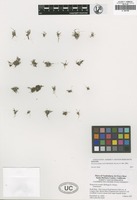
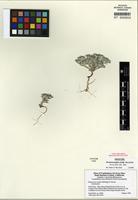
2 Images see all

Isotype of Ancistrocarphus keilii Morefield [family ASTERACEAE]
Previous
Next

Name

Identification
Isotype of Ancistrocarphus keilii Morefield [family ASTERACEAE ] (stored under name); Verified by J.D. Morefield,, Hesperevax acaulis (Kellogg) Greene [family ASTERACEAE ] Verified by Not on sheet,
Related name
  • Hesperevax acaulis
  • Ancistrocarphus keilii
Common name
  • Santa Ynez groundstar, Flora of North America Vol. 19

Flora

Entry for Ancistrocarphus keilii Morefield [family COMPOSITAE]
Herbarium
Flora of North America (FNA)
Collection
Flora of North America
Resource Type
Reference Sources
Entry From
Flora of North America, Vol 19,
Names
Ancistrocarphus keilii Morefield [family COMPOSITAE], Novon, 14: 464, fig. 1. 2004
Treatment Author(s)
James D. Morefield
Information
Plants 0.5–1(–2) cm. Stems 0. Leaves basal, petiolate, largest 8–10(–18) × 1(–2) mm, some ± grading into pistillate paleae (by reduction or loss of blades and expansion of petiole bases, resembling aristate phyllaries); bases (of petioles) expanded, 3-nerved, yellowish tan, parchment-like, closely involucral. Heads borne singly amidst surrounding leaves (see discussion below), 2.5–3.5 mm. Phyllaries 0. Receptacles broadly hourglass-shaped, 0.9–1.3 mm. Pistillate paleae: wings obscure, incurved, lanceolate, ± involute. Staminate paleae 5(–7), broadly spatulate, 1.8–2.8 mm, slightly surpassed by pistillate; apices incurved, ± involute, obtuse to rounded, apiculate, shortly scarious, not spinose. Staminate corollas ± zygomorphic, 0.9–1.3 mm, lobes 4, unequal (1–2 enlarged). Cypselae 1–1.4 × 0.5–0.6 mm, transverse bands 0.
Conservation Status
of conservation concern;
Phenology
mar-apr (spring)
Altitude range
40–130 m;
Distribution
USA Calif.
Discussion
Unlike Ancistrocarphus filagineus, A. keilii has no obvious dispersal mechanism. Its cypselae appear to germinate more or less in place from previous years’ plants, often producing dense, turflike growths of dozens to hundreds of individuals (these sometimes resemble leafy glomerules of heads; each head is on a separate plant with its own root). Lack of dispersal may explain its very limited geographic range in the Santa Ynez River drainage of Santa Barbara County. Its range does not appear to overlap with that of A. filagineus, which is found farther inland to the east and north. No other Filagininae have been found mixed with A. keilii, suggesting that its habitat is fairly distinctive.
Ancistrocarphus keilii is known from only three collections and appears to occur in relatively vulnerable habitats (J. D. Morefield 2004).

Related Materials

  • Terms and Conditions
  • Privacy Policy
  • Cookie Policy
  • Cookie Settings
  • Accessibility
  • Help
  • Contact Us
  • Facebook
  • Twitter
ITHAKA

JSTOR is part of ITHAKA, a not-for-profit organization helping the academic community use digital technologies to preserve the scholarly record and to advance research and teaching in sustainable ways.

©2000-2026 ITHAKA. All Rights Reserved. JSTOR®, the JSTOR logo, JPASS®, Aluka®, and ITHAKA® are registered trademarks of ITHAKA.

╳