

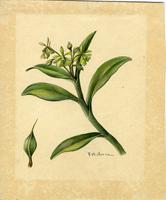
Name
Identification
Amphiglottis difformis (Jacq.) Britton [family ORCHIDACEAE ]
Related name
- Amphiglottis difformis
Flora
Entry for Epidendrum floridense Hágsater [family ORCHIDACEAE]
Herbarium
Flora of North America (FNA)
Collection
Flora of North America
Resource Type
Reference Sources
Entry From
Flora of North America, Vol 26,
Names
Epidendrum floridense Hágsater [family ORCHIDACEAE], Icon. Orchid., 2(1): plate 133. 1993
Amphiglottis difformis (Jacquin) Britton [family ORCHIDACEAE]
Treatment Author(s)
Eric Hágsater
Information
Plants cespitose, 6–26 cm. Roots basal, 1–2 mm diam. Stems unbranched, sinuous, terete, 5–23 cm. Leaves throughout length of stem; petiole to 25 mm; blade narrowly elliptic, 2-lobed, 2–6.7 × 0.7–2.3 cm, leathery-succulent. Inflorescences nearly corymbose; peduncle less than 1 cm; floral bracts triangular-ovate, to 12 mm. Flowers 4–14, resupinate, simultaneous, green; sepals wide open, narrowly obovate-elliptic, 5-veined, 12–15 × 3–5 mm, nearly leathery, apex acute to rounded; petals linear-oblanceolate, 3-veined, 11–12 × 2–2.5 mm, membranaceous, apex acute; lip widely cordate, 5–9 × 9–18.5 mm, usually with pair of shallow sinuses in front, fleshy-thickened toward center, apex somewhat notched, 2-callose; column 7–8.5 mm; clinandrium entire, erose, covering anther; anther transversely reniform, with prominent beak in front; ovary 22–28 mm. Capsules nearly globose; pedicel 20 mm; body 16–20 × 10–13 mm.
Phenology
dec-feb (winter), mar-apr (spring), aug (summer), sep-oct (fall)
Altitude range
0–30 m;
Distribution
USA Fla.
Discussion
Epidendrum floridense is pollinated by male night moths: Anticarsia gemmatilis, Phyprosopus callitrichoides, and Lymire edwardsii (G. J. Goss 1977). The flowers produce copious nectar within the nectar tube; in some cases nectar overflows, and a drop is found in front of the callus. The species is threatened because of increasing intensities of winter freezes.
Previous authors have cited this species as Epidendrum difforme Jacquin and considered it to be highly variable and widespread throughout the Neotropics. Field and herbarium studies have shown that it is not a single highly variable species but rather a complex of about 50 species (L. M. Sánchez and E. Hágsater 1997). Most of these can be easily recognized by a series of characters including: terete or compressed stems, simultaneous or successive flowering, few or many flowers, shape of the lip and petals, veining, fimbriation of the clinandrium, shape of the nectarium, presence or absence of nectar, distribution, and ecological and elevational preferences. Thus many names previously relegated to synonymy are being recognized, and many new species described. The Florida plants are clearly distinct from the true Epidendrum difforme, which, among other characteristics, has stems that are strongly compressed laterally and is endemic to the Windward Antilles.