JSTOR Global Plants Home
  • Home
  • Browse
  • About
  • Access
  • Account
    • Saved Items
    • Profile
  • Log in

Global Plants

Skip to Main Content
  • JSTOR Global Plants Home
  • Global Plants

    • Browse
    • About
    • Access
    • Account
      • Saved Items
      • Profile
Log in
  • Browse
  • About
  • Access
  • Account
    • Saved Items
    • Profile
Advanced Search

Compilation
Amaryllis banksiana

2 Images see all

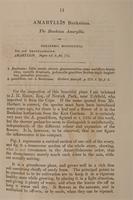
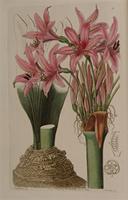
Amaryllis Banksiana. Print from Edward's Botanical Register
The Banksian Amaryllis
Previous
Next

Name

Identification
Amaryllis banksiana Lindl. [family AMARYLLIDACEAE ]
Related name
  • Amaryllis banksiana

Flora

Entry for BRUNSVIGIA slateriana Benth. [family AMARYLLIDACEAE]
Herbarium
Royal Botanic Gardens, Kew (K)
Collection
Flora Capensis
Resource Type
Reference Sources
Entry From
Flora Capensis, page 171, (1897) Author: (By J. G. BAKER).
Names
BRUNSVIGIA slateriana Benth. [family AMARYLLIDACEAE], Gen. Plant. iii. 727;—Baker, Handb. Amaryllid. 97.
Ammocharis slateriana Kunth [family AMARYLLIDACEAE], Enum. v. 613.
Amaryllis banksiana Lindl. [family AMARYLLIDACEAE], in Bot. Reg. 1842, t. 11.
Information
bulb globose, 4–5 in. diam.; tunics membranous, pale brown; leaves 6, lorate, suberect, glaucescent, 1 in. broad when young, not developed till after the flowers; peduncle stout, compressed, 1/2 ft. long, above 1/2 in. diam.; flowers 15–20 in an umbel; pedicels 3–4 in. long; spathe-valves lanceolate-deltoid, shorter than the pedicels; perianth-limb horizontal, bright rose-red, 1/2 in. long, cut down nearly to the ovary; segments lanceolate, 1/4 in. broad; stamens and style declinate, shorter than the perianth-segments; ovary turbinate, 1/4 in. long. null
Distribution
SOUTH AFRICA without locality.
Notes
Known only from the figure cited, which was drawn from a plant flowered by J. H. Slater, Esq., at Newick Park, Uckfield, in 1849.

Related Materials

  • Terms and Conditions
  • Privacy Policy
  • Cookie Policy
  • Cookie Settings
  • Accessibility
  • Help
  • Contact Us
  • Facebook
  • Twitter
ITHAKA

JSTOR is part of ITHAKA, a not-for-profit organization helping the academic community use digital technologies to preserve the scholarly record and to advance research and teaching in sustainable ways.

©2000-2026 ITHAKA. All Rights Reserved. JSTOR®, the JSTOR logo, JPASS®, Aluka®, and ITHAKA® are registered trademarks of ITHAKA.

╳