JSTOR Global Plants Home
  • Home
  • Browse
  • About
  • Access
  • Account
    • Saved Items
    • Profile
  • Log in

Global Plants

Skip to Main Content
  • JSTOR Global Plants Home
  • Global Plants

    • Browse
    • About
    • Access
    • Account
      • Saved Items
      • Profile
Log in
  • Browse
  • About
  • Access
  • Account
    • Saved Items
    • Profile
Advanced Search

Compilation
Amaranthus watsonii

8 Images see all

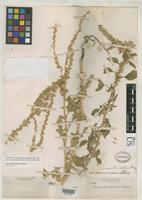
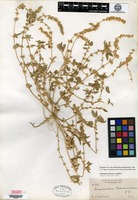
Holotype of Amaranthus watsonii Standley, P.C. 1914 [family AMARANTHACEAE]
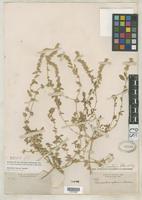
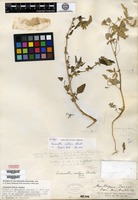
Isotype of Amaranthus watsonii Standley, P.C. 1914 [family AMARANTHACEAE]
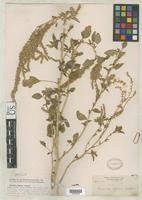
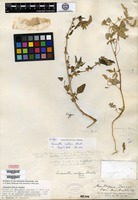
Type of Amaranthus watsonii Standley [family AMARANTHACEAE]
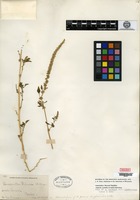
Filed as Amaranthus watsonii Standl. [family AMARANTHACEAE]
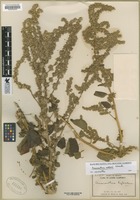
Type of Amaranthus watsonii Standley [family AMARANTHACEAE]
Type of Amaranthus torreyi (A. Gray) Bentham ex S. Watson var. suffruticosus Uline & W. L. Bray [family AMARANTHACEAE]
Type of Amaranthus palmeri S. Watson var. glomeratus Uline & W. L. Bray [family AMARANTHACEAE]
Previous
Next

Name

Identification
Amaranthus watsonii Standley, P.C. 1914 [family AMARANTHACEAE ] (stored under name); Verified by Not on sheet,
Related name
  • Amaranthus watsonii
Common name
  • Watson’s amaranth, Flora of North America Vol. 4

Flora

Entry for Amaranthus watsonii Standley [family AMARANTHACEAE]
Herbarium
Flora of North America (FNA)
Collection
Flora of North America
Resource Type
Reference Sources
Entry From
Flora of North America, Vol 4,
Names
Amaranthus watsonii Standley [family AMARANTHACEAE], Bull. Torrey Bot. Club, 41: 505. 1914
Past names
watsoni
Treatment Author(s)
Sergei L. Mosyakin
Kenneth R. Robertson
Information
Plants pubescent and glandular-pubescent, especially on bracts. Stems ascending to erect, usually much-branched, 0.1–1 m; branches usually ascending. Leaves: petiole shorter than or equaling blade; blade ovate, obovate to elliptic, or oblong-elliptic, 1–8 × 0.5–4 cm, base broadly cuneate to nearly rounded, margins entire, plane or slightly undulate, apex obtuse to emarginate, usually with terminal mucro. Inflorescences mostly terminal, erect spikes to panicles, usually thick and uninterrupted, with few axillary clusters in basal part of plant. Bracts: of pistillate flowers with long-excurrent midrib, 3–4 mm, longer than tepals, apex long-acuminate or mucronulate; of staminate flowers 2.5–4 mm, usually equaling outer tepals, apex long-acuminate or mucronulate. Pistillate flowers: tepals with dark midribs not excurrent, spatulate to fan-shaped, 1.7–2.2 mm, apex obtuse, with terminal mucro; style branches spreading; stigmas 2(–3). Staminate flowers: tepals 5, equal or subequal, 1.5–2(–3) mm, apex acute or almost obtuse; inner tepal apex acuminate or mucronulate; stamens 3–5. Utricles light brown to brown, obovoid to subglobose, 1.5–2 mm, shorter than tepals, walls thin, smooth or indistinctly rugose. Seeds dark reddish brown to nearly black, (0.8–)1–1.2 mm diam., shiny.
Phenology
dec-feb (winter), mar-may (spring), jun-aug (summer), sep-nov (fall)
Altitude range
0–100 m;
Distribution
Mexico (Baja California)Mexico (Baja California Sur)Mexico (Sonora)Europe (reported as rare).Europe (non-naturalized casual alien).USA Ariz.USA Calif.

Related Materials

  • Terms and Conditions
  • Privacy Policy
  • Cookie Policy
  • Cookie Settings
  • Accessibility
  • Help
  • Contact Us
  • Facebook
  • Twitter
ITHAKA

JSTOR is part of ITHAKA, a not-for-profit organization helping the academic community use digital technologies to preserve the scholarly record and to advance research and teaching in sustainable ways.

©2000-2026 ITHAKA. All Rights Reserved. JSTOR®, the JSTOR logo, JPASS®, Aluka®, and ITHAKA® are registered trademarks of ITHAKA.

╳