JSTOR Global Plants Home
  • Home
  • Browse
  • About
  • Access
  • Account
    • Saved Items
    • Profile
  • Log in

Global Plants

Skip to Main Content
  • JSTOR Global Plants Home
  • Global Plants

    • Browse
    • About
    • Access
    • Account
      • Saved Items
      • Profile
Log in
  • Browse
  • About
  • Access
  • Account
    • Saved Items
    • Profile
Advanced Search

Compilation
Amaranthus tuberculatus

11 Images see all

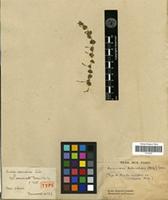
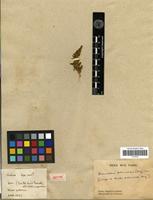
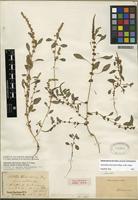
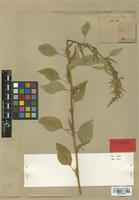
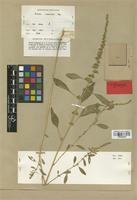
Type of Acnida cannabina L. var. concatenata Moq. [family AMARANTHACEAE]
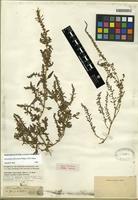
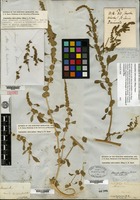
Type of Amaranthus tuberculatus (Moq.) J.D. Sauer [family AMARANTHACEAE]
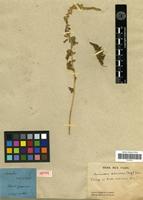
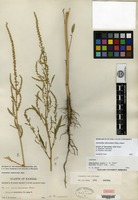
Isotype of Acnida tuberculata Moq. [family AMARANTHACEAE]
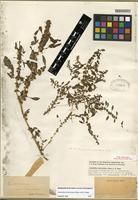
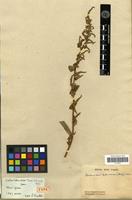
Type of Amaranthus tuberculatus (Moq.) J.D. Sauer [family AMARANTHACEAE]
Isotype of Acnida tuberculata Moq. [family AMARANTHACEAE]
Type of Amaranthus tuberculatus (Moquin-Tandon) Sauer [family AMARANTHACEAE]
Isotype of Amaranthus rudis J. D. Sauer [family AMARANTHACEAE]
Holotype of Acnida tuberculata Moq. [family AMARANTHACEAE]
Type of Amaranthus tuberculatus (Moq.) J.D. Sauer [family AMARANTHACEAE]
Type of Acnida tuberculata Moq. [family AMARANTHACEAE]
Previous
Next

Name

Identification
Amaranthus tuberculatus (Moq.) J. D. Sauer [family AMARANTHACEAE ] (stored under name); Verified by Data not digitized, Acnida tuberculata Moq. [family AMARANTHACEAE ] Verified by Data not digitized,
Related name
  • Acnida tamariscina
  • Acnida cannabina
  • Amaranthus tuberculatus
  • Acnida tuberculata
Common name
  • Rough-fruited water-hemp, Flora of North America Vol. 4
  • rough-fruit amaranth, Flora of North America Vol. 4
  • tall water-hemp, Flora of North America Vol. 4

Flora

Entry for Amaranthus tuberculatus (Moquin-Tandon) J. D. Sauer [family AMARANTHACEAE]
Herbarium
Flora of North America (FNA)
Collection
Flora of North America
Resource Type
Reference Sources
Entry From
Flora of North America, Vol 4,
Names
Amaranthus tuberculatus (Moquin-Tandon) J. D. Sauer [family AMARANTHACEAE], Madroño, 13: 18. 1955
Acnida tuberculata Moquin-Tandon [family AMARANTHACEAE], in A. P. de Candolle and A. L. P. P. de Candolle, Prodr., 1 3(2): 277. 1849
Acnida altissima Riddell ex Moquin-Tandon [family AMARANTHACEAE]
Acnida altissima var. prostrata (Uline & W. L. Bray) Fernald [family AMARANTHACEAE]
Acnida altissima var. subnuda (S. Watson) Fernald [family AMARANTHACEAE]
Acnida concatenata (Moquin-Tandon) Small [family AMARANTHACEAE]
Acnida subnuda (S. Watson) Standley [family AMARANTHACEAE]
Acnida tamariscina (Nuttall) Alph. Wood [family AMARANTHACEAE]
Acnida tamariscina var. concatenata (Moquin-Tandon) Uline & W. L. Bray [family AMARANTHACEAE]
Acnida tamariscina var. tuberculata (Moquin-Tandon) Uline & W. L. Bray [family AMARANTHACEAE]
Amaranthus ambigens Standley [family AMARANTHACEAE]
Amaranthus rudis J. D. Sauer [family AMARANTHACEAE]
Treatment Author(s)
Sergei L. Mosyakin
Kenneth R. Robertson
Information
Stems erect to sometimes ascending or rarely prostrate, branched, rarely simple, usually (0.5–)1–2(–3) m. Leaves: petiole 1/4–1/2 length of blade; blade ovate or obovate proximally, oblong or elliptic to narrowly lanceolate distally, 1.5–15 × 0.5–3 cm, base cuneate, margins entire, plane, apex obtuse or rounded to acute. Inflorescences terminal, linear spikes to panicles, occasionally interrupted-moniliform, remote, globose glomerules. Bracts: of pistillate flowers 1–2 mm; of staminate flowers with inconspicuous to prominent midrib, 1–2 mm, apex acuminate to short-subulate. Pistillate flowers: tepals absent or 1–2, often rudimentary, 1–3 mm; style branches ± erect; stigmas 3. Staminate flowers: tepals 5, inner tepals with prominent midribs excurrent as rigid spines or not, equal to unequal, 2–3 mm, apex obtuse to acute or acuminate or indistinctly mucronulate; stamens 5. Utricles dark brown to reddish brown, not ribbed, obovoid to subglobose, 1.5–2 mm, thin, almost smooth or irregularly rugose, indehiscent, irregularly dehiscent, or dehiscence regularly circumscissile. Seeds dark reddish brown to dark brown, 0.7–1 mm diam., shiny.
Phenology
jun-aug (summer), sep-nov (fall)
Altitude range
0–1000 m;
Distribution
usually not naturalizedin Europe and other continents.USA Ala.USA Ark.USA Calif.USA Colo.USA Conn.USA Del.USA Ga.USA IdahoUSA Ill.USA Ind.USA IowaUSA Kans.USA Ky.USA La.USA MaineUSA Md.USA Mass.USA Mich.USA Minn.USA Miss.USA Mo.USA Nebr.USA Nev.USA N.H.USA N.Mex.USA N.Y.USA N.C.USA N.Dak.USA OhioUSA Pa.USA S.C.USA S.Dak.USA Tenn.USA Tex.USA Vt.USA Wash.USA W.Va.USA Wis.Canada Man.Canada Ont.Canada P.E.I.Canada Que.
Discussion
J. D. Sauer (1967b, 1972b) separated Amaranthus rudis (A. tamariscinus) as distinct from A. tuberculatus, based primarily on absence of tepals in the pistillate flowers and indehiscent fruits. Recent work by D. B. Pratt and L. G. Clark (2001) showed that those characteristics are not constant and they recognized only one polymorphic species, A. tuberculatus. Long-term observations by K. R. Robertson strongly support the inclusion of A. rudis within A. tuberculatus. Amaranthus rudis probably was originally native to the Great Plains west of the Mississippi, from Texas to Iowa. Amaranthus tuberculatus likely had a more northern range, north of Missouri and Tennessee to the Great Lakes. The emerging evolutionary differentiation between the two related taxa was erased by agriculture and human-induced introduction and invasion. Amaranthus tuberculatus has become a major weed of agricultural fields and other disturbed habitats and is now introduced in parts of North America far outside its original range.
Native/Introduced
introduced;
introduced

Related Materials

  • Terms and Conditions
  • Privacy Policy
  • Cookie Policy
  • Cookie Settings
  • Accessibility
  • Help
  • Contact Us
  • Facebook
  • Twitter
ITHAKA

JSTOR is part of ITHAKA, a not-for-profit organization helping the academic community use digital technologies to preserve the scholarly record and to advance research and teaching in sustainable ways.

©2000-2026 ITHAKA. All Rights Reserved. JSTOR®, the JSTOR logo, JPASS®, Aluka®, and ITHAKA® are registered trademarks of ITHAKA.

╳