JSTOR Global Plants Home
  • Home
  • Browse
  • About
  • Access
  • Account
    • Saved Items
    • Profile
  • Log in

Global Plants

Skip to Main Content
  • JSTOR Global Plants Home
  • Global Plants

    • Browse
    • About
    • Access
    • Account
      • Saved Items
      • Profile
Log in
  • Browse
  • About
  • Access
  • Account
    • Saved Items
    • Profile
Advanced Search

Compilation
Amaranthus tristis

15 Images see all

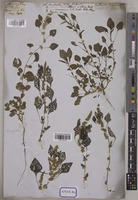
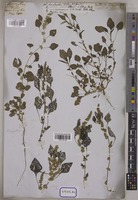
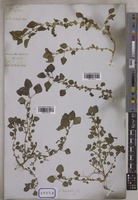
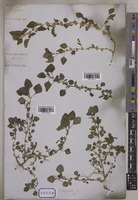
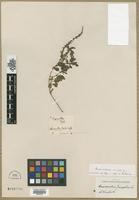
Amaranthus tristis Wall. [family AMARANTHACEAE]
Filed as Amaranthus dubius Mart. ex Thell. [family AMARANTHACEAE]
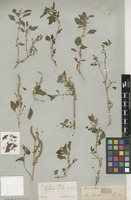
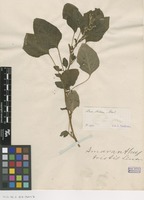
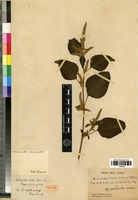
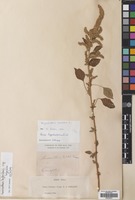
Amaranthus tristis Wall. [family AMARANTHACEAE]
Filed as Amaranthus dubius Mart. ex Thell. [family AMARANTHACEAE]
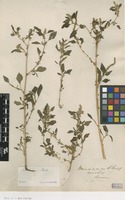
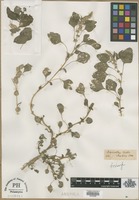
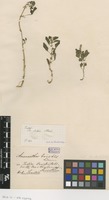
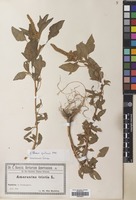
Filed as Amaranthus tristis L. [family AMARANTHACEAE]
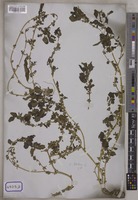
Type of Amaranthus tristis L. var. leptostachys Moq. [family AMARANTHACEAE]
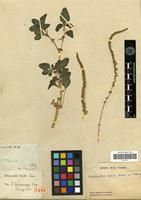
Amaranthus tristis Wall. [family AMARANTHACEAE]
Type of Amaranthus tristis L. var. xanthostachys Moq. [family AMARANTHACEAE]
Filed as Amaranthus dubius Mart. ex Thell. [family AMARANTHACEAE]
Amaranthus tristis Wall. [family AMARANTHACEAE]
Filed as Phaeanthus tristis Nutt. [family ANNONACEAE]
Filed as Amaranthus hybridus L. subsp. hybridus [family AMARANTHACEAE]
Previous
Next

Name

Identification
Amaranthus dubius Thell. [family AMARANTHACEAE ] (stored under name); Verified by Not on sheet, Amaranthus tristis L. [family AMARANTHACEAE ] Verified by Not on sheet,
Related name
  • Amaranthus tristis
  • Amaranthus dubius

Flora

Entry for Amaranthus dubius Mart. [family AMARANTHACEAE]
Herbarium
Royal Botanic Gardens, Kew (K)
Collection
Flora Zambesiaca
Resource Type
Reference Sources
Entry From
FZ, Vol 9, Part 1, page 28, (1988) Author: C. C. Townsend
Names
Amaranthus dubius Mart. [family AMARANTHACEAE], Pl. Hort. Acad. Erlang.: 197 (1814) nomen nudum, ex Thell., Fl. Adv. Montpellier: 203 (1912).—Schinz in Engl. & Prantl Pflanzenfam. ed. 2, 16 C: 38 (1934).—Hauman in F.C.B. 2: 30 (1951).—Aellen in Hegi, Illustr. Fl. Mitteleurop. ed. 2, 3, 2: 476 (1959).—J.H. Ross Fl. Natal: 158 (1973).—Brenan in Journ. S. Afr. Bot. 47: 464 (1981). TAB. 10 fig. J. Type, cultivated specimen from Erlangen Botanic Garden.
Amaranthus tristis [family AMARANTHACEAE], sensu Moq. in DC., Prodr. 13, 2: 260 (1849) non L.
Amaranthus patulus [family AMARANTHACEAE], sensu Baker & Clarke in F.T.A. 6, 1: 33 (1909) non Bertol.
Amaranthus dubius var. crassespicatus Suesseng. [family AMARANTHACEAE], in Mitt. Bot. Staatss. München 1: 73 (1951). Type from Tanzania.
Information
Erect annual herb, mostly up to c. 90 cm. (rarely to 1.5 m.) tall. Stem rather slender to stout, usually branched, angular, glabrous or increasingly furnished upwards (especially in the inflorescence) with short to rather long, multicellular hairs. Leaves glabrous, or thinly and shortly pilose on the inferior surface of the primary venation, long-petiolate (petioles up to c. 8.5 cm. long, sometimes longer than the lamina), lamina ovate or rhomboid-ovate, 1.5–8 (12) × 0.7–5 (8) cm., blunt or retuse at the apex with a distinct, fine mucro formed by the percurrent nerve, cuneate (usually shortly so) at the base; leaf axils without spines. Flowers green, in the lower part of the plant in axillary clusters 4–10 cm. in diam., towards the ends of the stem and branches the leafless clusters approximated to form simple or (the terminal at least) branched spikes c. 3–15 (25) cm. long and 6–8 (10) mm. wide. Lower clusters of flowers entirely female, the spikes generally showing a few male flowers at the apices only (rarely in more than the apical 1 cm.), occasionally with male flowers also scattered among the lower female flowers. Bracts and bracteoles deltoid-ovate, pale-membranous with an erect reddish awn formed by the excurrent green midrib, bracteoles somewhat shorter than or subequalling the perianth, rarely slightly exceeding it. Perianth segments (4) 5, those of the female flowers c. 1.5–2.75 mm. long, narrowly oblong or spathulate oblong, obtuse or sometimes (particularly those approaching the male flowers) acute, mucronulate, frequently with a greenish dorsal vitta above; those of the male flowers broadly lanceolate or lanceolate-oblong, generally acuminate, only the thin midrib green. Stigmas 3, flexuose or reflexed, c. 0.75–1 mm. long. Capsule subequalling the perianth, ovoid-urceolate, with a short inflated beak below the style base, c. 1.5–1.75 mm., circumcissile, the lid strongly rugulose below the neck. Seed 1–1.25 mm., compressed, black, shining, faintly reticulate.
Range
This species is of tropical American origin but now occurs almost throughout the tropics of the world; it is scarcer as an adventive in temperate regions than A. spinosus
Distribution
Mozambique T Tete, ii.1932, Guerra 41 (COI).Mozambique M Delagoa Bay, viii, Wilms 1250 (K).Mozambique GI Inhambane, dans les jardins potagers, 10 m., iv.1936, Gomes e Sousa 1721 (K).Mozambique MS Sabi R., 27.vi.1950, Chase 2456 (BM; SRGH).Mozambique Z Quelimane Distr., Namagoa, s.d., Faulkner K5 (K).Malawi S Blantyre, Glyn Jones Street, 1040 m., 7.v.1980, Townsend 2144 (K).Zambia E Luangwa Valley, Mulila Tundwe, Munkanya, 21.xii.1967, Phiri 18 (K).Zimbabwe C Harare, Forbes Ave, 11.x.1971, Biegel 3613 (K; LISC; MAL; MO; PRE; SRGH).Mozambique N Mandimba, 7.iii.1942, Hornby 3721 (PRE).Malawi N “N. Nyassa”, 1896, Whyte s.n. (K).Zimbabwe N Kariba, Gorge just below the Dam wall, 456 m., v.1960. Goldsmith 76/60.Zambia N Mbala Distr.. Mpulungu, Lake Tanganyika, 880 m., 29.xii.1951, Richards 180 (K).
Notes
A. dubius is the only known polyploid Amaranthus, and it is postulated by Grant (Canadian Journ. Bot. 37: 1063–70 (1959)) that it arose as an allotetraploid with A. spinosus as one parent and possibly A. quitensis as the other - a conclusion disputed by Pal & Khoshoo (Curr. Sci. 34: 370–371 (1965)). Hybrids between A. dubius and A. spinosus appear to occur freely where these two species are associated, and Srivasta, Pal & Nair (Rev. Palaeobot. Palynol. 23: 287–291 (1977)) claim that these may be distinguished by the presence of micrograins among the pollen. Such hybrids will certainly occur in tropical Africa, and the Faulkner specimen cited above may be such. No apparent hybrid was seen when I found the two species growing together in Blantyre. In spite of various characters used in the literature, I have been able to find no infallible means by which A. spinosus can be separated from A. dubius other than by the presence or absence of spines, though the generally considerably greater number of terminal male flowers in the spikes of A. spinosus seems a reasonably reliable character where only \"tops\" are collected. According to Srivasta, Pal & Nair (loc. cit.) the pollen of A. dubius has larger pores than those of A. spinosus. The leaves of A. dubius are commonly broader than those of A. spinosus. but this is a highly comparative character.

Related Materials

  • Terms and Conditions
  • Privacy Policy
  • Cookie Policy
  • Cookie Settings
  • Accessibility
  • Help
  • Contact Us
  • Facebook
  • Twitter
ITHAKA

JSTOR is part of ITHAKA, a not-for-profit organization helping the academic community use digital technologies to preserve the scholarly record and to advance research and teaching in sustainable ways.

©2000-2026 ITHAKA. All Rights Reserved. JSTOR®, the JSTOR logo, JPASS®, Aluka®, and ITHAKA® are registered trademarks of ITHAKA.

╳