

Compilation
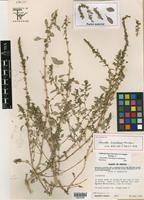
Amaranthus tamaulipensis
1 Images see all
Name
Identification
Amaranthus tamaulipensis Henrickson [family AMARANTHACEAE ] (stored under name); Verified by Plant Resources Center staff, 2010
Related name
- Amaranthus tamaulipensis
Flora
Entry for Amaranthus tamaulipensis Henrickson [family AMARANTHACEAE]
Herbarium
Flora of North America (FNA)
Collection
Flora of North America
Resource Type
Reference Sources
Entry From
Flora of North America, Vol 4,
Names
Amaranthus tamaulipensis Henrickson [family AMARANTHACEAE], Sida, 18: 800, f igs. 4G, 5, 8, map. 1999
Treatment Author(s)
Sergei L. Mosyakin
Kenneth R. Robertson
Information
Plants glabrous. Stems erect or ascending (sometimes prostrate), stramineous or suffused with red, branched at base, sparsely branched to simple distally, 15–30(–60) cm. Leaves: petiole 1/2 as long as to equaling blade; blade ovate or rhombic-ovate, 1–2.7 × 0.5–1.5 cm, base cuneate to broadly cuneate, margins entire, plane or slightly undulate (rarely erose), apex obtuse, rounded, or broadly cuneate, with mucro. Inflorescences axial glomerules from base of plant to tip, interrupted at nodes or crowded in terminal, leafy spikes. Bracts lanceolate-ovate to lanceolate, shorter than tepals, apex acute. Pistillate flowers: tepals 5, not imbricate, distal parts expanded, oblong-spatulate, subequal, 1.1–1.6(–2.1) mm, scarious, margins entire, apex obtuse or rounded, with excurrent midrib; style branches erect; stigmas 3. Staminate flowers: basal and scattered on lateral shoots; tepals 4–5, oblong-ovate, equal, 1.2–1.6 mm, apex acute to acuminate; stamens 3(–4). Utricles brownish at maturity, obovoid to obpyramidal, slightly biconvex, 1.5–1.7 mm, longer than tepals, rugose to tuberculate, dehiscence regularly circumscissile. Seeds black to reddish brown, lenticular to subglobose, 1–1.2 mm, smooth, shiny.
Phenology
mar-may (spring), jun-aug (summer), sep-nov (fall)
Altitude range
0–100 m;
Distribution
Mexico (San Luis Potosí).Mexico (Tabasco).Mexico (Tamaulipas).USA Tex.
Discussion
Amaranthus tamaulipensis seems to be related to A. brandegeei Standley sensu stricto, which was described from northern Mexico, and A. dubius. According to Henrickson, A. tamaulipensis differs from A. brandegeei in having erect, not reflexed, tepals; from A. dubius it can be distinguished by the characters of its tepals, distinctly rugose, not smooth, fruits with smooth, turban-shaped style base, and three stamens. The proper placement and taxonomic status of A. tamaulipensis remain problematic and need further study.