JSTOR Global Plants Home
  • Home
  • Browse
  • About
  • Access
  • Account
    • Saved Items
    • Profile
  • Log in

Global Plants

Skip to Main Content
  • JSTOR Global Plants Home
  • Global Plants

    • Browse
    • About
    • Access
    • Account
      • Saved Items
      • Profile
Log in
  • Browse
  • About
  • Access
  • Account
    • Saved Items
    • Profile
Advanced Search

Compilation
Amaranthus greggii

8 Images see all

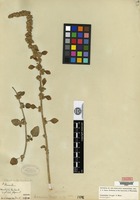
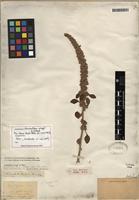
Holotype of Amaranthus greggii S. Watson [family AMARANTHACEAE]
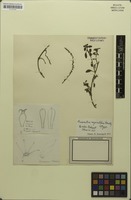
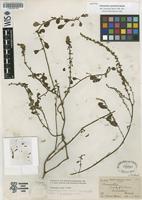
Isosyntype of Amaranthus myrianthus Standl. [family AMARANTHACEAE]
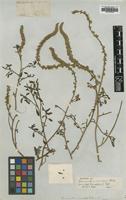
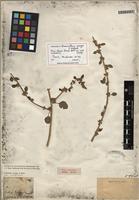
Type of Amaranthus annectens Blake [family AMARANTHACEAE]
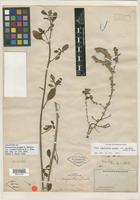
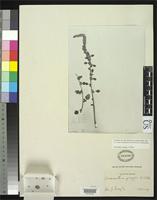
Holotype of Amaranthus greggii var. muelleri Uline & W. L. Bray [family AMARANTHACEAE]
Isolectotype of Amaranthus greggii S. Watson [family AMARANTHACEAE]
Isotype of Amaranthus myrianthus Standl. [family AMARANTHACEAE]
Isolectotype of Amaranthus greggii S. Watson [family AMARANTHACEAE]
Filed as Amaranthus greggii Watson, S. 1877 [family AMARANTHACEAE]
Previous
Next

Name

Identification
Amaranthus annectens Blake [family AMARANTHACEAE ] (stored under name); Amaranthus greggii S.Watson [family AMARANTHACEAE ]
Related name
  • Amaranthus greggii
  • Amaranthus annectens
  • Amaranthus myrianthus
Common name
  • Josiah amaranth, Flora of North America Vol. 4
  • Gregg’s amaranth, Flora of North America Vol. 4

Flora

Entry for Amaranthus greggii S. Watson [family AMARANTHACEAE]
Herbarium
Flora of North America (FNA)
Collection
Flora of North America
Resource Type
Reference Sources
Entry From
Flora of North America, Vol 4,
Names
Amaranthus greggii S. Watson [family AMARANTHACEAE], Proc. Amer. Acad. Arts, 12: 274. 1877
Past names
Amarantus
Treatment Author(s)
Sergei L. Mosyakin
Kenneth R. Robertson
Information
Plants glabrous or glabrescent. Stems erect to ascending, much-branched from base, 0.3–1 m. Leaves: petiole shorter than blade; blade ovate, or rhombic-ovate to elliptic, 1.5–4 × 0.5–2 cm, thick, coarse, base cuneate to rounded, margins entire, plane or irregularly undulate, apex rounded-obtuse to emarginate, with terminal mucro. Inflorescences mostly terminal, spikes to panicles, usually erect, thick, flexible. Bracts: of pistillate flowers with short, excurrent midrib, 1.5–2.5 mm, shorter than tepals, apex acute or acuminate; of staminate flowers shorter than tepals, apex acute. Pistillate flowers: tepals with dark, prominent midrib not excurrent, spatulate, subequal, 2–3 mm, apex obtuse to subacute, with terminal mucro; style branches spreading; stigmas 3. Staminate flowers: tepals 5, equal, 2–3 mm, apex obtuse to subacute; inner tepals: with apex indistinctly mucronulate; stamens 5. Utricles light brown, elliptic, 3 mm, equaling tepals, walls somewhat fleshy, smooth, indehiscent. Seeds dark brown, 1.2–1.7 mm diam., shiny.
Phenology
jun-aug (summer), sep-nov (fall)
Altitude range
0–50 m;
Distribution
Mexico.USA La.USA Tex.
Discussion
According to J. D. Sauer (1972b), Amaranthus myrianthus Standley most probably is a hybrid between A. arenicola and A. greggii.

Related Materials

  • Terms and Conditions
  • Privacy Policy
  • Cookie Policy
  • Cookie Settings
  • Accessibility
  • Help
  • Contact Us
  • Facebook
  • Twitter
ITHAKA

JSTOR is part of ITHAKA, a not-for-profit organization helping the academic community use digital technologies to preserve the scholarly record and to advance research and teaching in sustainable ways.

©2000-2026 ITHAKA. All Rights Reserved. JSTOR®, the JSTOR logo, JPASS®, Aluka®, and ITHAKA® are registered trademarks of ITHAKA.

╳