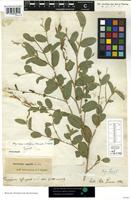
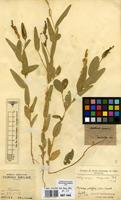
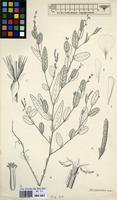
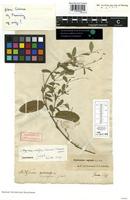
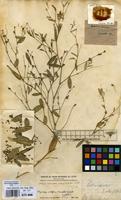
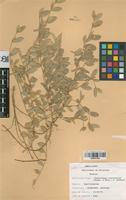
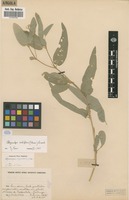
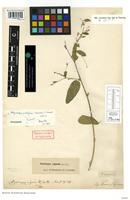
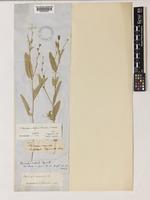
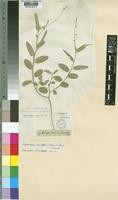
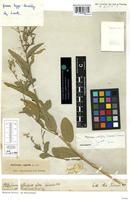
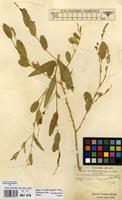
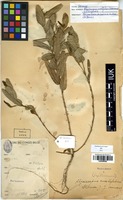
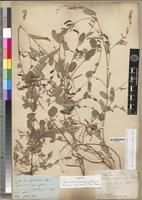
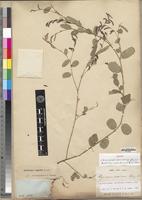
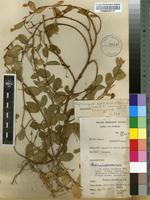
Erect or spreading annual herb, sometimes woody at the base, 20–60 cm. tall. Stems puberulous or pubescent, later almost glabrous. Leaves uni-foliolate; leaflet elliptic or oblong to narrowly lanceolate, 1–10 cm. long, 0.6–3 cm. wide, acute to emarginate and mucronulate at the apex, subcordate, finely puberulous and with some hairs on the nerves beneath; reticulation obscure; petiole 2–8 mm. long; petiolule 0.7–1.5 mm. long; stipules lanceolate, 0.5–2 cm. long. Inflorescences terminal or leaf-opposed, sometimes paniculate, very lax, the internodes between the 3–7 pairs of flowers long; rhachis 3–11 cm. long; peduncle 3–4 cm. long; pedicels 1–2 mm. long; primary bracts ovate-lanceolate, 4–5 mm. long, 1.5–2 mm. wide, acuminate, deciduous; secondary bracts 1.5–2.5 mm. long. Calyx puberulous or pubescent; tube 1.5–2 mm. long; teeth narrowly triangular, 3–4 mm. long, 0.5 mm. wide, acuminate, not imbricate. Standard orange-buff to pink or reddish-violet, rarely whitish, 4–6 mm. long, 3–4 mm. wide; wings purplish-mauve; keel pale greenish. Pods 1.8–2.5 cm. long, well exserted from the calyx, not constricted between the articles; articles 2–8, subcylindrical, 2.5–4 mm. long, 2–2.5 mm. wide, with raised reticulate ridges, puberulous. Seeds brown, oblong-ellipsoid, slightly compressed, longest dimension 2.5 mm., shorter dimension 1.5 mm., 1.2 mm. thick. Fig. 71/B, p. 492.Zanzibar. See note