JSTOR Global Plants Home
  • Home
  • Browse
  • About
  • Access
  • Account
    • Saved Items
    • Profile
  • Log in

Global Plants

Skip to Main Content
  • JSTOR Global Plants Home
  • Global Plants

    • Browse
    • About
    • Access
    • Account
      • Saved Items
      • Profile
Log in
  • Browse
  • About
  • Access
  • Account
    • Saved Items
    • Profile
Advanced Search

Compilation
Aloe thompsoniae

3 Images see all

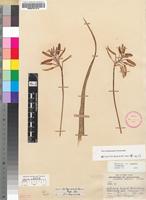
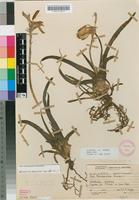
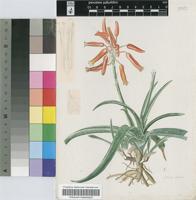
Lectotype of Aloe thompsoniae Groenew. [family ASPHODELACEAE]
Filed as Aloe thompsoniae Groenew. [family ASPHODELACEAE]
Aloe thompsoniae Groenew.
Previous
Next

Name

Identification
Aloe thompsoniae Groenew. [family ASPHODELACEAE ]
Related name
  • Aloe thompsoniae

Flora

Entry for Aloe thompsoniae [family ALOACEAE]
Herbarium
South African National Biodiversity Institute, Compton Herbarium, Cape Town (SAM)
Collection
Flora of Southern Africa
Resource Type
Reference Sources
Entry From
Flora of South Africa, (2003) Author: Dr J.P. Roux
Names
Aloe thompsoniae [family ALOACEAE]
Information
Much-branched grass aloe 150-200 mm tall, suckering to form dense recumbent to pendent clumps; roots fusiform. Leaves 12-18 in a rosette, lorate, 90-200 x 4-15 mm, often reflexed, canaliculate, apple-green, margins dentate. Inflorescences 1-3 from a rosette, sim­ple, with subcapitate to conical racemes; pedun­cle 150-200 mm long, with sterile bracts; bracts deltoid-acute, 9-10 x 3-6 mm, 5-8-nerved. Flowers orange, 22-28 mm long; all segments free; pedicels 9-24 mm long. Anthers not exserted. Ovary 4.0-5.0 x 1.5-2.0 mm, lemon-yellow; style not exserted. Flowering time December to January.
Habitat
In this species and A. nubigena (no. 13), both of which are often pendent on rocks, the pedun­cle is bent, often in a U-curve, so that the raceme is always vertical. A. thompsoniae dif­fers from A. nubigena by being a smaller plant with stiffer leaves and bracts with distinct veins. In A. thompsoniae the leaves are rosulate, but in A. nubigena they are often distichous. This species has rosulate leaves and bracts with dis­tinct veins, and grows in clumps, whereas A. soutpansbergensis (no. 12) has fewer leaves, which are distichous when young, and bracts with obscure veins, and is often solitary.
Use
11. Aloe thompsoniae Groenew. in Tydskrif vir Wetenskap en Kuns 14: 64 (1936a) sphalm. thompsoni; Reynolds: t. 980 (1945); Reynolds: 131 (1950); Jeppe: 119 (1969); Born-man & D.S.Hardy: 21 (1972); Glen & G.F.Sm.: 37 (1995); B.-E. van Wyk & G.F.Sm.: 292 (1996). Type: Northern Province, Haenertsburg, Thompson PRE274 (PRE, lecto.!).
Range
Occurring in the Northern Province and Mpumalanga. This is one of the few species of Aloe that requires permanent high humidity. It is found on cliffs in the mist belt on this part of the eastern escarpment. Map 8.

Related Materials

  • Terms and Conditions
  • Privacy Policy
  • Cookie Policy
  • Cookie Settings
  • Accessibility
  • Help
  • Contact Us
  • Facebook
  • Twitter
ITHAKA

JSTOR is part of ITHAKA, a not-for-profit organization helping the academic community use digital technologies to preserve the scholarly record and to advance research and teaching in sustainable ways.

©2000-2026 ITHAKA. All Rights Reserved. JSTOR®, the JSTOR logo, JPASS®, Aluka®, and ITHAKA® are registered trademarks of ITHAKA.

╳