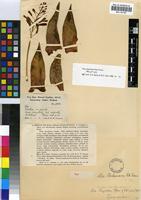
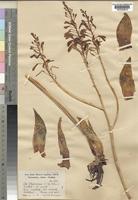
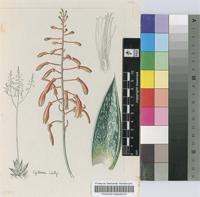
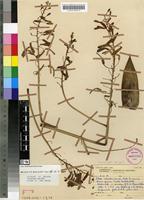
Plants 75-150 mm tall excluding inflorescence, in dense clumps. Leaves ± 6-8, ascendÂing, held at an angle of at least 45° to the horiÂzontal, lanceolate-deltoid, 40-90 x 25-40 mm, channelled to V-shaped in section, deep green to grey-green with white spots. Inflorescence usuÂally simple, rarely 1- or 2-branched; peduncles 200-500 mm long; bracts narrowly deltoid, very thin, scarious, white, 4-6 x 2-3 mm, 1-nerved. Flowers very pale to dull pink, 20-30 mm long; outer segments free for ± 7 mm, inner segments adnate to outer; pedicels 17-23 mm long. Anthers exserted up to 1 mm. Ovary 5.0-7.0 x 1.5-2.0 mm, green to reddish brown; style exserted up to 1 mm. Fruit not seen. Flowering time January to February. Figure 8.
Habitat
Differences between this species and A. variegata are discussed under that species. In addiÂtion, individual rosettes of A. sladeniana have far fewer leaves than rosettes of A. variegata. In A. sladeniana the leaf margins are finely notched, but in A. dinteri they are finely toothed. Other characters distinguishing these two species are the same as those distinguishing between A. variegata and A. dinteri.
Use
41. Aloe sladeniana Pole Evans in Annals of the Bolus Herbarium 3: 13 (1920); J.R.Brown: 3 (1946); Reynolds: 212 (1950); Reynolds: t. 1122 (1952); Jeppe: 18 (1969); Solch, Roessler & Merxm.: 18 (1970); Bornman & D.S.Hardy: 79 (1972); Jankowitz: 52 (1975). Type: Namibia, Pearson PSME9000 (BOL!).
Range
Endemic to central Namibia. This species seems to replace A. variegata (no. 40) in the part of Namibia where winter rainfall gives way to rain (or drought) in all seasons. A. sladeniana in turn makes way for A. dinteri (no. 42) where summer rain predominates. Like the Namibian populations of A. variegata, this species occurs on decomposed granites in areas with very cold winters. Map 32.