South African National Biodiversity Institute, Compton Herbarium, Cape Town (SAM)
Collection
Flora of Southern Africa
Resource Type
Reference Sources
Entry From
Flora of South Africa, (2003) Author: Dr J.P. Roux
Names
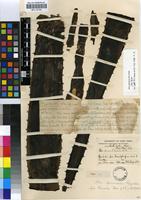
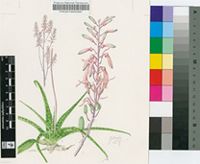
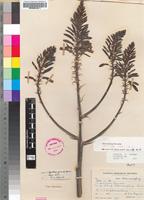
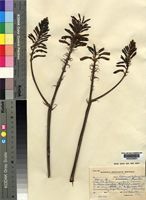
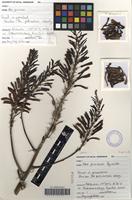
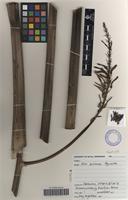
Aloe pruinosa [family ALOACEAE]
Information
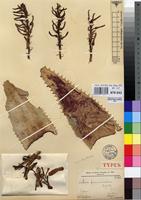
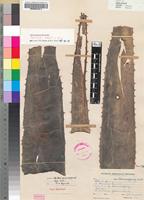
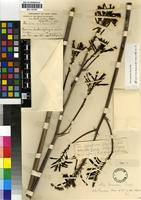
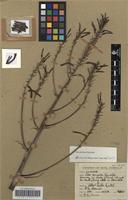
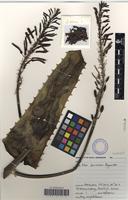
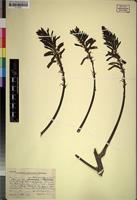
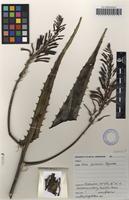
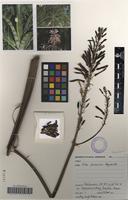
Plants solitary, 250-600 mm tall excluding inflorescence, with a 300-500 mm long, often prostrate stem. Leaves 16-24, erect to spreading, 500-750 x 60-100 mm, channelled, upper surÂface with many whitish spots, irregularly arranged or in transverse bands, lower surface with more numerous spots in more distinct bands. Inflorescence with 11-20 ultimate branches, 1.4-2.0 m tall; racemes conical, sub-lax; bracts deltoid-acuminate, 5-12 x 2-3 mm, 5-7-nerved. Flowers brownish red to darkish pink with greyish powdery bloom, 24-33 mm long, subclavate above basal constriction; outer segments free for 5-7 mm, inner segments adnate to outer; pedicels 8-12 mm long. Anthers exserted up to 2 mm. Ovary 6.0-8.0 x 1.5-3.0 mm, green; style exserted l-A mm. Fruit not seen. Flowering time February to March.
Habitat
This plant is smaller than A. dyeri (no. 50) but larger than other members of the section. A. pruinosa is more readily short-stemmed than that species, and there are differences in leaf markings and in the size and colour of the flowÂers. A. pruinosa differs from all other southern African Aloe species in having a copious dull grey bloom on the flowers, pedicels and pedunÂcle. Although similar in many respects to A. greenii (no. 49), it is distinguishable from that species in the field in all seasons; the differÂences are given under A. greenii.
Use
51. Aloe pruinosa Reynolds in Journal of South African Botany 2: 122 (1936a); Reynolds: 250 (1950); Jeppe: 75 (1969); Bornman & D.S.Hardy: 113 (1972); B.-E. van Wyk & G.F.Sm.: 218 (1996). Type: KwaZulu-Natal, Pietermaritzburg, Reynolds 377 (PRE, holo.!; BOL!).
Range
Aloe pruinosa is endemic to shade in Acacia woodland in the KwaZulu-Natal midlands. It occurs on heavy loam in areas of fairly high summer rainfall. Map 39.