South African National Biodiversity Institute, Compton Herbarium, Cape Town (SAM)
Collection
Flora of Southern Africa
Resource Type
Reference Sources
Entry From
Flora of South Africa, (2003) Author: Dr J.P. Roux
Names
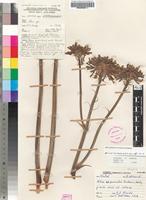
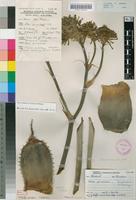
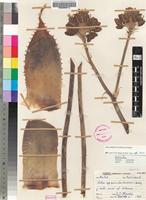
Aloe prinslooi [family ALOACEAE]
Information
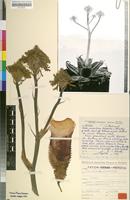
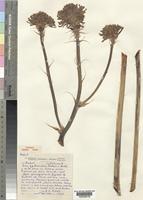
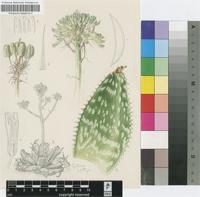
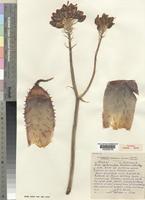
Plants stemless, 150-250 mm tall excluding inflorescence, usually solitary. Leaves 16-30, 140-200 x 40-80 mm, biconvex to slightly channelled, both surfaces with few to many white spots, usually irregular, sometimes in transverse bands, denser on upper surface. Inflorescence with 2-5 ultimate branches, ± 600 mm tall; racemes dense, capitate; bracts deltoid-cirrhous, 15-30 x 3-5 mm, ± 7-nerved. Flowers greenish white becoming tinged with pink, 13—17 mm long; segments free for almost half their length; pedicels 12-30 mm long, erect. Anthers not or hardly exserted. Ovary 4.0-10.0 x 2.0-2.5 mm, green; style not or hardly exsertÂed. Fruit 14-18 x 10-12 mm, grey. Seeds ± 4.0 x 2.5 x 1.0 mm, hardly winged, brown. Flowering time August to September.
Habitat
The very dense, almost spherical racemes of small, whitish flowers distinguish this species from all others in this section. Sterile specimens are easily confused with A. maculata (no. 45), and there seems to be no vegetative character that distinguishes unambiguously between these two species.
Use
60. Aloe prinslooi I.Verd. & D.S.Hardy in The Flowering Plants of Africa 37: t. 1453 (1965); Jeppe: 102 (1969); Bornman & D.S.HarÂdy: 91 (1972); D.S.Hardy: 513 (1974); B.-E. van Wyk & G.F.Sm.: 216 (1996). Type: KwaZulu-Natal, (PRE!).
Range
Aloe prinslooi occurs in the dense grass understorey of open woodland in the KwaZulu-Natal midlands. The soil is thin, the rainfall relÂatively low, the summers are hot and the winters very cold. Map 43.