JSTOR Global Plants Home
  • Home
  • Browse
  • About
  • Access
  • Account
    • Saved Items
    • Profile
  • Log in

Global Plants

Skip to Main Content
  • JSTOR Global Plants Home
  • Global Plants

    • Browse
    • About
    • Access
    • Account
      • Saved Items
      • Profile
Log in
  • Browse
  • About
  • Access
  • Account
    • Saved Items
    • Profile
Advanced Search

Compilation
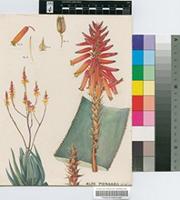
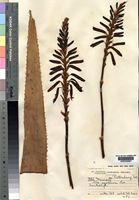
Aloe pienaarii

2 Images see all

Aloe pienaarii Pole-Evans
Type of Aloe pienaarii Pole-Evans [family ALOACEAE]
Previous
Next

Name

Identification
Aloe pienaarii Pole-Evans [family ASPHODELACEAE ]
Related name
  • Aloe pienaarii

Flora

Entry for Aloe pienaarii Pole Evans [family ALOACEAE]
Herbarium
Royal Botanic Gardens, Kew (K)
Collection
Flora Zambesiaca
Resource Type
Reference Sources
Entry From
FZ, Vol 12, Part 3, page 48, (2001) Author: S. Kativu
Names
Aloe pienaarii Pole Evans [family ALOACEAE], in Trans. Roy. Soc. S. Africa 5: 27 (1915). TAB. 12.3.21, fig. B. Type from South Africa (Northern Prov.).
Aloe cryptopoda [family ALOACEAE], sensu Reynolds, Aloes S. Africa: 331 (1950).
Information
Perennial herb, solitary, or suckering to form small groups of plants, acaulescent or with a very short stem. Leaves in a compact rosette, stiffly erect; lamina up to 90 cm long, 12–15 cm wide toward the base, lanceolate-attenuate, dark greyish-green, tinged reddish in dry conditions, slightly rough on the surface, without spots; margin with pungent deltoid brown-tipped teeth 1–2 mm long and 4–6 mm apart. Inflorescences 1–3, erect, 1.25–1.75 m high; peduncle 4–8-branched; branches curving upwards, subtended by scarious deltoid bracts c. 20 × 20 mm, with a few sterile bracts below each raceme. Racemes 25–50 × 7 cm, narrowly cylindric-acuminate, very densely flowered, the buds covered by the bracts; bracts 17–22 × 12 mm, broadly ovate-acuminate, scarious, many-nerved; pedicels c. 20 mm long, elongating to 28 mm in fruit. Perianth bright scarlet, green-tipped in bud, sometimes opening to yellow but the base remains red, 30–45 mm long, 9–10 mm in diameter across the ovary, cylindric-trigonous; outer segments free to the base, tips scarcely spreading. Stamens and stigma exserted c. 3 mm. Capsule c. 25 × 13 mm, oblong-ovoid, dark yellowish-brown. Seeds 4 × 5 mm, black, with narrow speckled wings.
Habitat
Sandy soils among rocks in light deciduous woodland
Altitude range
140–600 m (to 1300 m in Transvaal).
600
140
Distribution
Mozambique M 13 km east of Namaacha, fl. 5.v.1962, Leach 11380 (SRGH); Namaacha Distr., Umbeluzi R. bridge, near Goba, fr. 18.viii.1967, Gomes e Sousa & Balsinhas 4937 (COI; K).
Distribution (external)
South Africa (Northern Prov., Mpumalanga)
Swaziland
Notes
A. pienaarii is readily distinguished from A. cryptopoda, with which it has been considered synonymous since Christian’s paper in J. S. African Bot. 6: 117 (1940), by its much larger, differently shaped floral bracts. Plants are also generally larger, with marginal teeth of the leaves closer together, inflorescences more branched, racemes more densely flowered, and perianths longer.

Related Materials

  • Terms and Conditions
  • Privacy Policy
  • Cookie Policy
  • Cookie Settings
  • Accessibility
  • Help
  • Contact Us
  • Facebook
  • Twitter
ITHAKA

JSTOR is part of ITHAKA, a not-for-profit organization helping the academic community use digital technologies to preserve the scholarly record and to advance research and teaching in sustainable ways.

©2000-2026 ITHAKA. All Rights Reserved. JSTOR®, the JSTOR logo, JPASS®, Aluka®, and ITHAKA® are registered trademarks of ITHAKA.

╳