JSTOR Global Plants Home
  • Home
  • Browse
  • About
  • Access
  • Account
    • Saved Items
    • Profile
  • Log in

Global Plants

Skip to Main Content
  • JSTOR Global Plants Home
  • Global Plants

    • Browse
    • About
    • Access
    • Account
      • Saved Items
      • Profile
Log in
  • Browse
  • About
  • Access
  • Account
    • Saved Items
    • Profile
Advanced Search

Compilation
Aloe peglerae

7 Images see all

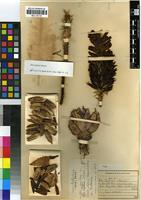
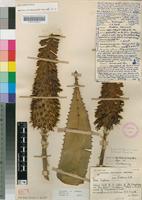
Type of Aloe peglerae Schoenland [family ASPHODELACEAE]
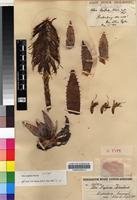
Type of Aloe peglerae Schonland [family ASPHODELACEAE]
Aloe peglerae Schönland
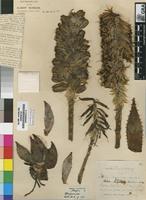
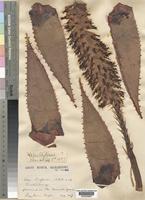
Isotype of Aloe peglerae Schönland [family ASPHODELACEAE]
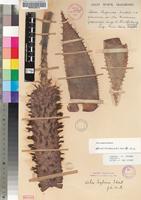
Filed as Aloe peglerae Schönland [family ASPHODELACEAE]
Isotype of Aloe peglerae Schönland [family ASPHODELACEAE]
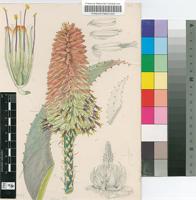
Aloe peglerae Schönland [family ALOACEAE]
Previous
Next

Name

Identification
Aloe peglerae Schönland [family ASPHODELACEAE ]
Related name
  • Aloe peglerae

Flora

Entry for Aloe peglerae [family ALOACEAE]
Herbarium
South African National Biodiversity Institute, Compton Herbarium, Cape Town (SAM)
Collection
Flora of Southern Africa
Resource Type
Reference Sources
Entry From
Flora of South Africa, (2003) Author: Dr J.P. Roux
Names
Aloe peglerae [family ALOACEAE]
Information
Plants solitary, 350^-50 mm tall. Leaves ± 30, arcuate-incurved, 175-250 x 50-70 mm, greyish, undersurface with a median line of prickles near apex, margins dentate. Inflores­cence a dense, cylindric raceme; peduncle 300-400 mm long; bracts ovate-acuminate, 12-16 x 6-7 mm, 3-7-nerved. Flowers magen­ta-red in bud, greenish cream when open, 25-30 mm long, cylindric, mouth very slightly upturned; all segments free. Anthers exserted 7-25 mm, purple. Ovary ±6x3 mm, green; style exserted 15-20 mm, pale brown. Fruit not seen. Flowering time July to August. Figure 3.
Habitat
This species is similar to A. broomii (no. 26) and A. chlorantha (no. 27) in its solitary habit and incurved leaves. Unlike these two species, in which the leaves are yellow-green, the leaves of A. peglerae are glaucous blue. It is smaller than these in all parts except the flower. The leaves have a median line of prickles on the lower surface near the apex, and the brilliant red flowers and small bracts of this species contrast with the dull brownish or greenish flowers, half hidden by the bracts, in the other two species mentioned.
Use
25. Aloe peglerae Schonland in Records of the Albany Museum 1: 120 (1904); A.Berger: 174 (1908); Pole Evans: t. 149 (1924c); Reynolds: 160 (1950); Jeppe: 5 (1969); Bornman & D.S.Hardy: 51 (1972); B.-E. van Wyk& G.F.Sm.: 150 (1996). Type: North-West, Rustenburg, Pegler921 (BOL, holo.!; GRA!, PRE!, SAM!).
Range
Endemic to North-West and Gauteng. Aloe peglerae formerly occurred in large numbers on stone pavements on the Witwatersrand, but has largely been exterminated by urban develop­ment and collectors. Where it still occurs, it is found in places with almost no soil; most of such little soil as there is, is humus formed by the decay of old leaves of this plant. The surround­ing vegetation is scanty grassland. Map 19.

Related Materials

  • Terms and Conditions
  • Privacy Policy
  • Cookie Policy
  • Cookie Settings
  • Accessibility
  • Help
  • Contact Us
  • Facebook
  • Twitter
ITHAKA

JSTOR is part of ITHAKA, a not-for-profit organization helping the academic community use digital technologies to preserve the scholarly record and to advance research and teaching in sustainable ways.

©2000-2026 ITHAKA. All Rights Reserved. JSTOR®, the JSTOR logo, JPASS®, Aluka®, and ITHAKA® are registered trademarks of ITHAKA.

╳