Entry From
Flora of South Africa, (2003) Author: Dr J.P. Roux
Habitat
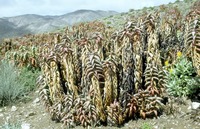
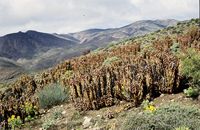
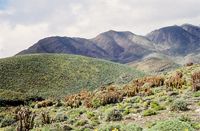
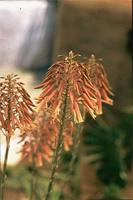
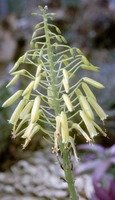
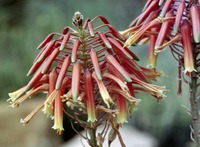
The habit of A. pearsonii recalls that of species of section 15, Macrifoliae, but the leaves of this species are much thicker, shorter and more leathery than any in that section. The flowers of A. pearsonii are narrow and cylin-dric, borne on long pedicels, unlike any in secÂtion Macrifoliae. These characters, and microÂscopical details of the leaf surface anatomy, indicate that this species is much better placed here. The leaves of A. pearsonii are smaller than those of any species in section Aloe except A. arenicola (no. 88). In that species the stems are decumbent, and the leaves are incurved, with white spots and cartilaginous margins. In A. pearsonii the stems are rigidly erect, the leaves are reflexed and unspotted and the margins are not cartilaginous. A. dabenorisana (no. 90) is similar to A. pearsonii in having reflexed leaves, but in that species the leaves are larger, the plant is pendent not erect, and the anthers and style are not or hardly exserted. This is one of the slowest-growing of all aloes, and some of the large shrubs in the Richtersveld are probaÂbly several hundred years old.
Use
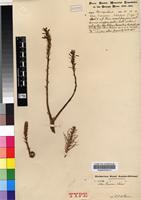
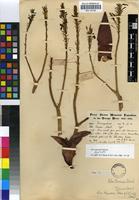
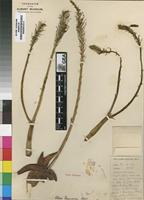
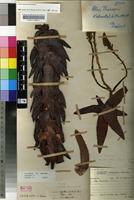
86. Aloe pearsonii Schonland in Records of the Albany Museum 2: 229 (1911); H.Pearson: 190 (1911); Reynolds: 366 (1950); Jeppe: 23 (1969); Solch, Roessler & Merxm.: 18 (1970); D.S.Hardy: t. 1594 (1970); Bornman & D.S.HarÂdy: 201 (1972); Jankowitz: 44 (1975); B.-E. van Wyk & G.F.Sm.: 118 (1996). Type: Northern Cape, Richtersveld, Pearson 6091 (GRA, holo.!; BM!, BOL!, SAM!; PRE, photo.!).