JSTOR Global Plants Home
  • Home
  • Browse
  • About
  • Access
  • Account
    • Saved Items
    • Profile
  • Log in

Global Plants

Skip to Main Content
  • JSTOR Global Plants Home
  • Global Plants

    • Browse
    • About
    • Access
    • Account
      • Saved Items
      • Profile
Log in
  • Browse
  • About
  • Access
  • Account
    • Saved Items
    • Profile
Advanced Search

Compilation
Aloe mzimbana

5 Images see all

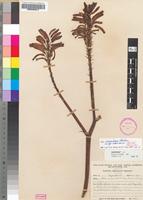
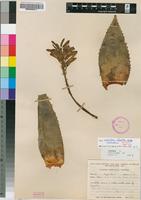
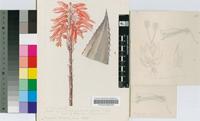
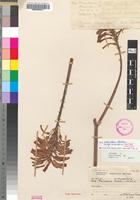
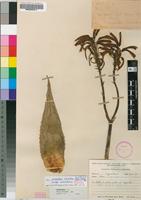
Holotype of Aloe mzimbana I.Verd. & Christian [family ASPHODELACEAE]
Aloe mzimbana I.Verd. & Christian
Holotype of Aloe mzimbana I.Verd. & Christian [family ASPHODELACEAE]
Previous
Next

Name

Identification
Aloe mzimbana I.Verd. & Christian [family ASPHODELACEAE ]
Related name
  • Aloe mzimbana

Flora

Entry for Aloe mzimbana I. Verd. & Christian [family ALOACEAE]
Herbarium
Royal Botanic Gardens, Kew (K)
Collection
Flora Zambesiaca
Resource Type
Reference Sources
Entry From
FZ, Vol 12, Part 3, page 48, (2001) Author: S. Kativu
Names
Aloe mzimbana I. Verd. & Christian [family ALOACEAE], in Fl. Pl. S. Africa 21: pl. 838 (1941). —Reynolds, Aloes Nyasaland: 26 (1954); Aloes Trop. Africa & Madagascar: 111 (1966). —Brummitt in Wye Coll. Malawi Proj. Rep.: 66 (1973). —Court, Succ. Fl. South. Africa: 126 (1981). —Carter in F.T.E.A., Aloaceae: 18, fig. 5, 1–3, pl. 2 (1994). TAB. 12.3.18, fig. A. Type: Malawi, 29 km northeast of Mzimba, fl. 8.vi.1938, Pole Evans & Erens 643 (PRE, holotype).
Aloe sp. near lateritia [family ALOACEAE], sensu Brenan et al. in Mem. New York Bot. Gard. 9: 89 (1954).
Aloe cf. lateritia [family ALOACEAE], sensu Binns, First Check List Herb. Fl. Malawi: 62 (1968).
Information
Perennial herb, suckering to form dense groups of plants, acaulescent. Leaves in a dense rosette, erect-spreading but curving inwards in the dry season; lamina 20–35 cm long, 7–8 cm wide toward the base, ovate-lanceolate, greyish-green, with few to many large, elongated, whitish spots on both surfaces; margin with pungent deltoid brown-tipped teeth 2–3 mm long and 8–10(15) mm apart; sap yellow. Inflorescence erect to 60 cm high; peduncle 1–3(6)-branched; branches spreading, with several sterile bracts below each raceme. Racemes 8–15 × 6 cm, subcapitate, very densely flowered; bracts 8–14 × 3–4 mm, ovate-lanceolate, buff with darker veining; pedicels held erect, 15–20 mm long, elongating to 30 mm in fruit. Perianth bright coral-red, 30–35 mm long, c. 8 mm in diameter across the ovary, slightly narrowed above the ovary, then curved and widening toward the mouth, cylindric-trigonous; outer segments free for c. one-third, with tips scarcely spreading. Stamens and stigma slightly exserted. Capsule stipitate for 1.5–3 mm, c. 20 × 12 mm, ovoid, dark yellowish-brown. Seeds 3.5 × 6–7 mm, blackish with broad sparsely speckled wings.
Habitat
Montane and watershed grassland, on rock outcrops
Altitude range
1280–2300 m.
2300
1280
Distribution
Zambia N Mbala Distr., Chila Lake, fl. & fr. 4.v.1936, B.D. Burtt 5864 (K); Kawambwa Distr., Kalungwishi R., fl. & fr. 16.viii.1958, Fanshawe 4682 (K; SRGH).Malawi N Rumphi Distr., 3 km southwest of Chelinda Rest House, fl. vi.1958, Reynolds 8643 (K; PRE; SRGH); Mzimba Distr., 30.5 km north of Mzimba, fl. 15.vi.1958, Reynolds 8622 (K; PRE; SRGH).Zambia E Nyika Plateau, fl. viii.1968, G. Williamson 966 (SRGH).
Distribution (external)
Tanzania
Dem. Rep. Congo
Notes
Populations from Tanzania and into Zambia tend to produce distinctly spotted leaves and capitate racemes, whereas those from nearer the type locality in Malawi produce unspotted or only sparsely spotted leaves and more cylindrical racemes.

Related Materials

  • Terms and Conditions
  • Privacy Policy
  • Cookie Policy
  • Cookie Settings
  • Accessibility
  • Help
  • Contact Us
  • Facebook
  • Twitter
ITHAKA

JSTOR is part of ITHAKA, a not-for-profit organization helping the academic community use digital technologies to preserve the scholarly record and to advance research and teaching in sustainable ways.

©2000-2026 ITHAKA. All Rights Reserved. JSTOR®, the JSTOR logo, JPASS®, Aluka®, and ITHAKA® are registered trademarks of ITHAKA.

╳