JSTOR Global Plants Home
  • Home
  • Browse
  • About
  • Access
  • Account
    • Saved Items
    • Profile
  • Log in

Global Plants

Skip to Main Content
  • JSTOR Global Plants Home
  • Global Plants

    • Browse
    • About
    • Access
    • Account
      • Saved Items
      • Profile
Log in
  • Browse
  • About
  • Access
  • Account
    • Saved Items
    • Profile
Advanced Search

Compilation
Aloe mketiensis

5 Images see all

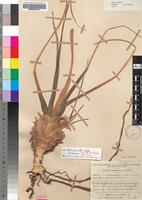
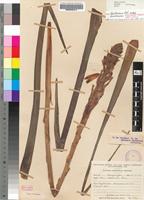
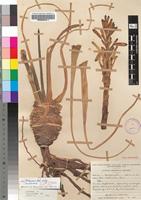
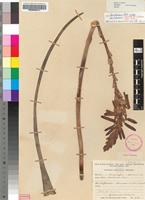
Holotype of Aloe mketiensis Christian [family ASPHODELACEAE]
Aloe mketiensis Christian
Holotype of Aloe mketiensis Christian [family ASPHODELACEAE]
Previous
Next

Name

Identification
Aloe mketiensis Christian [family ASPHODELACEAE ]
Related name
  • Aloe mketiensis

Flora

Entry for Aloe nuttii Baker [family ALOACEAE]
Herbarium
Royal Botanic Gardens, Kew (K)
Collection
Flora Zambesiaca
Resource Type
Reference Sources
Entry From
FZ, Vol 12, Part 3, page 48, (2001) Author: S. Kativu
Names
Aloe nuttii Baker [family ALOACEAE], in Hooker’s Icon. Pl. 26: t. 2513 (1897); in F.T.A. 7: 457 (1898). —Berger in Engler, Pflanzenr. IV, fam. No. 38, III, II (Heft 33): 170 (1908). —Christian in Fl. Pl. S. Africa 20: pl. 762 (1940). —Brenan et al. in Mem. New York Bot. Gard. 9: 89 (1954). —Reynolds, Aloes Trop. Africa & Madagascar: 32 (1966). —Brummitt in Wye Coll. Malawi Proj. Rep.: 66 (1973). —Court, Succ. Fl. South. Africa: 149 (1981).—Carter in F.T.E.A., Aloaceae: 9, fig. 1, 1–5, pl. 1 (1994). TAB. 12.3.14. Syntypes: Zambia, Fwambo, south of Lake Tanganyika, fl. & fr. 1896, Nutt s.n. (K, syntype); Fwambo, fl. & fr. 1894, A. Carson 29 (K, syntype).
Aloe brunneo-punctata Engl. & Gilg [family ALOACEAE], in Warburg, Kunene-Samb.-Exped. Baum: 189 (1903). —Berger in Engler, Pflanzenr. IV, fam. No. 38, III, II (Heft 33): 170 (1908). Type from Angola.
Aloe corbisieri De Wild. [family ALOACEAE], Contrib. Fl. Katanga: 29 (1921). Syntypes from Dem. Rep. Congo.
Aloe mketiensis Christian [family ALOACEAE], in Fl. Pl. S. Africa 20: pl. 785 (1940). —Reynolds, Aloes Nyasaland: 43 (1954). Type from Tanzania.
Information
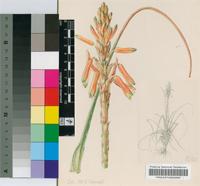
Perennial herb, solitary, or suckering to produce a cluster of 2–12 stems. Stems up to 20 cm long and 1.5–3 cm thick. Leaves rosulate, erect, grass-like, 40–50 cm long, linear, c. 1.5 cm wide, expanded to c. 4 cm wide at the base, tapering towards the apex, channelled on the upper surface, ± fleshy, bright green, white-spotted towards the base especially on the lower surface and occasionally spinulescent; margin with minute white cartilaginous teeth crowded at the leaf base, the teeth usually obsolescent towards the apex. Inflorescence simple, erect to 60–80 cm high; peduncle with large, orange-brown, sterile, papery bracts on the upper half, 2–4 cm apart. Raceme 15–25 × 8 cm, cylindric, ± densely flowered, with overlapping bracts in bud; bracts 1.5–2.5 × 1–2 cm, broadly ovate, apex acute; pedicels 2.5–3 cm long, elongating to 4 cm in fruit, red-tinged. Perianth coral-pink to orange-red, green-tipped, 35–40 mm long, 7–9 mm in diameter across the ovary, cylindric-trigonous, narrowing towards the mouth, base tapering into the pedicel; outer segments free for one-third to three-quarters with tips slightly spreading. Stamens scarcely exserted, reddish, style a little longer. Capsule stipitate for 1 mm, c. 2.5 × 1 mm, ovoid, buff. Seeds c. 3.5 × 5 mm, dark brown, narrowly winged.
Habitat
In montane and dambo grasslands, and in high rainfall Brachystegia woodlands
Altitude range
1450–2400 m.
2400
1450
Distribution
Zambia N Mbala (Abercorn), fl. 9.iii.1950, A.A. Bullock 2615 (BR; EA; K).Malawi N Rumphi Distr., Nyika Plateau, above Nchenachena, fl. 20.v.1956, Reynolds 8187 (K; PRE).Zambia W Kitwe, Kamfinsa R., fl. 23.ii.1958, Fanshawe 4281 (K).
Distribution (external)
Dem. Rep. Congo
Tanzania
Angola

Related Materials

  • Terms and Conditions
  • Privacy Policy
  • Cookie Policy
  • Cookie Settings
  • Accessibility
  • Help
  • Contact Us
  • Facebook
  • Twitter
ITHAKA

JSTOR is part of ITHAKA, a not-for-profit organization helping the academic community use digital technologies to preserve the scholarly record and to advance research and teaching in sustainable ways.

©2000-2026 ITHAKA. All Rights Reserved. JSTOR®, the JSTOR logo, JPASS®, Aluka®, and ITHAKA® are registered trademarks of ITHAKA.

╳