JSTOR Global Plants Home
  • Home
  • Browse
  • About
  • Access
  • Account
    • Saved Items
    • Profile
  • Log in

Global Plants

Skip to Main Content
  • JSTOR Global Plants Home
  • Global Plants

    • Browse
    • About
    • Access
    • Account
      • Saved Items
      • Profile
Log in
  • Browse
  • About
  • Access
  • Account
    • Saved Items
    • Profile
Advanced Search

Compilation
Aloe micracantha

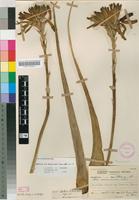
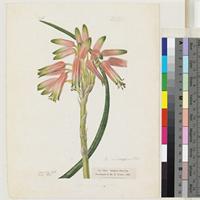
2 Images see all

Filed as Aloe micracantha Haw. [family ASPHODELACEAE]
Aloe micracantha Haworth original illustration from Curtis's Botanical Magazine
Previous
Next

Name

Identification
Aloe micracantha Haw. [family ASPHODELACEAE ]
Related name
  • Aloe micracantha

Flora

Entry for Aloe micracantha [family ALOACEAE]
Herbarium
South African National Biodiversity Institute, Compton Herbarium, Cape Town (SAM)
Collection
Flora of Southern Africa
Resource Type
Reference Sources
Entry From
Flora of South Africa, (2003) Author: Dr J.P. Roux
Names
Aloe micracantha [family ALOACEAE]
Information
Stemless grass aloe 350-500 mm tall, solitary; roots fusiform. Leaves 12-18 in a rosette, lorate, 300-500 x 20-40 mm, acuminate, with irregular white spots on both surfaces through­out or only near expanded bases, margins carti­laginous, dentate. Inflorescence a capitate raceme; peduncle 250-500 mm long, with sterile bracts; bracts ovate-acuminate, 22-27 x 5-7 mm, many-nerved. Flowers salmon-pink, 26-38 mm long; all segments free; pedicels 20-35 mm long, lengthening to ± 50 mm in fruit. Anthers not or hardly exserted. Ovary ±8x3 mm, salmon-pink; style exserted 1-2 mm. Fruit ± 28 x 12 mm, grey. Seeds black, in a semitranspar-ent white membranous sac forming wings, ± 6.0-7.0 x 4.0 x 1.5 mm including wing. Flowering time December to January.
Habitat
Characters that distinguish this species from all others in the section include the copious spots on both sides of the leaves, extending almost to the leaf tips; the flowers, pedicels and bracts which are all the same colour; and the distribution range, which is the southwestern-most in the group. The plant figured under this name in The Flowering Plants of South Africa 3: t. Ill (1923) is not this species but rather A. ecklonis (no. 19).
Use
20. Aloe micracantha Haw., Supplementum plantarum succulentarum 105 (1819); Sims: t. 2272 (1821); Link & Otto: t. 40 (1825); Salm-Dyck: 21,1.1 (1840); Baker: 159 (1880a); Baker: 306 (1896a); A.Berger: 169 (1908); Reynolds: 147 (1950); Jeppe: 126 (1969); Bornman & D.S.Hardy: 41 (1972); G.F.Sm.: 55 (1993); Glen & G.F.Sm.: 37 (1995); B.-E. van Wyk & G.F.Sm.: 276 (1996). Neotype: Burchell 4482 (K!).
Range
Found in KwaZulu-Natal and the Eastern Cape. This species occurs in well-drained, dry, sandy or stony places, often wedged between rocks. It is very difficult to maintain in cultiva­tion. Map 14.

Related Materials

  • Terms and Conditions
  • Privacy Policy
  • Cookie Policy
  • Cookie Settings
  • Accessibility
  • Help
  • Contact Us
  • Facebook
  • Twitter
ITHAKA

JSTOR is part of ITHAKA, a not-for-profit organization helping the academic community use digital technologies to preserve the scholarly record and to advance research and teaching in sustainable ways.

©2000-2026 ITHAKA. All Rights Reserved. JSTOR®, the JSTOR logo, JPASS®, Aluka®, and ITHAKA® are registered trademarks of ITHAKA.

╳