JSTOR Global Plants Home
  • Home
  • Browse
  • About
  • Access
  • Account
    • Saved Items
    • Profile
  • Log in

Global Plants

Skip to Main Content
  • JSTOR Global Plants Home
  • Global Plants

    • Browse
    • About
    • Access
    • Account
      • Saved Items
      • Profile
Log in
  • Browse
  • About
  • Access
  • Account
    • Saved Items
    • Profile
Advanced Search

Compilation
Aloe meyeri

7 Images see all

Aloe meyeri Van Jaarsv.
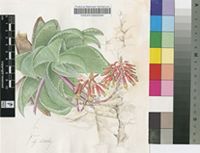
Holotype of Aloe meyeri Van Jaarsv. [family ASPHODELACEAE]
Aloe meyeri Van Jaarsv.
Holotype of Aloe meyeri Van Jaarsv. [family ASPHODELACEAE]
Aloe meyeri Van Jaarsv.
Previous
Next

Name

Identification
Aloe meyeri Van Jaarsv. [family ASPHODELACEAE ]
Related name
  • Aloe meyeri

Flora

Entry for Aloe meyeri [family ALOACEAE]
Herbarium
South African National Biodiversity Institute, Compton Herbarium, Cape Town (SAM)
Collection
Flora of Southern Africa
Resource Type
Reference Sources
Entry From
Flora of South Africa, (2003) Author: Dr J.P. Roux
Names
Aloe meyeri [family ALOACEAE]
Common names
A. richtersveldensis Venter & Beukes: 675 (1982). Type: Northern Cape, Richtersveld, Venter 8264 (BLFU, nolo.; K, PRE!).
Information
Plants pendent; stems simple or branched. Leaves in an elongated rosette ± 300 mm long; spreading to erect, not recurved, lanceolate, 130-200 x 30^-0 mm, dull green, sometimes tinged reddish brown. Inflorescence a simple, rarely branched, dense, capitate raceme, 150-250 mm long; peduncle reflexed, with sterile bracts; bracts ± 5 x 2-3 mm, 3-nerved. Flowers orange-red, tipped green, 20-23 mm long; all segments free; pedicels 17-20 mm long. Anthers exserted up to 3 mm. Ovary ± 4-5 x 2 mm, green; style exserted up to 3 mm. Fruit not seen. Flowering time December to February. Figure 16.
Habitat
Differences between this species on the one hand and A. perfoliata (no. 87) and A. arenico­la (no. 88) on the other are dealt with under those species. The leaves of A. meyeri are erect to spreading, unlike those of A. dabenorisana (no. 90), which are reflexed, and are smaller than those of that species. The inflorescence is smaller and the bracts are 3-nerved, not 1-nerved.
Use
89. Aloe meyeri Van Jaarsv. in Journal of South African Botany 47: 567 (1981); Vorster: 175 (1983); Glen & D.S.Hardy: t. 2065 (1993); B.-E. van Wyk & G.F.Sm.: 114 (1996). Type: Northern Cape, Richtersveld, Van Jaarsveld 6137 (NBG!).
Range
Aloe meyeri is endemic to the Northern Cape and grows in rock cracks on cliffs in one of the most arid parts of the winter-rainfall area. In the range of this species, most of the precipitation received is in the form of condensation from fog. Map 64.

Related Materials

  • Terms and Conditions
  • Privacy Policy
  • Cookie Policy
  • Cookie Settings
  • Accessibility
  • Help
  • Contact Us
  • Facebook
  • Twitter
ITHAKA

JSTOR is part of ITHAKA, a not-for-profit organization helping the academic community use digital technologies to preserve the scholarly record and to advance research and teaching in sustainable ways.

©2000-2026 ITHAKA. All Rights Reserved. JSTOR®, the JSTOR logo, JPASS®, Aluka®, and ITHAKA® are registered trademarks of ITHAKA.

╳