JSTOR Global Plants Home
  • Home
  • Browse
  • About
  • Access
  • Account
    • Saved Items
    • Profile
  • Log in

Global Plants

Skip to Main Content
  • JSTOR Global Plants Home
  • Global Plants

    • Browse
    • About
    • Access
    • Account
      • Saved Items
      • Profile
Log in
  • Browse
  • About
  • Access
  • Account
    • Saved Items
    • Profile
Advanced Search

Compilation
Aloe melanacantha

7 Images see all

Aloe melanacantha A.Berger
Filed as Aloe melanacantha A.Berger [family ASPHODELACEAE]
Aloe melanacantha A.Berger
Previous
Next

Name

Identification
Aloe melanacantha A.Berger [family ASPHODELACEAE ]
Related name
  • Aloe melanacantha

Flora

Entry for Aloe melanacantha [family ALOACEAE]
Herbarium
South African National Biodiversity Institute, Compton Herbarium, Cape Town (SAM)
Collection
Flora of Southern Africa
Resource Type
Reference Sources
Entry From
Flora of South Africa, (2003) Author: Dr J.P. Roux
Names
Aloe melanacantha [family ALOACEAE]
Information
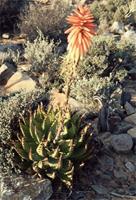
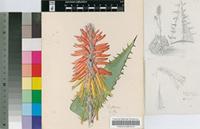
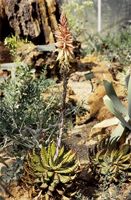
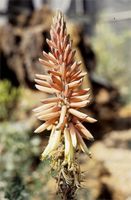
Plants short-stemmed, 200-300 mm tall ex­cluding inflorescence, usually solitary. Leaves densely rosulate, narrowly lanceolate, 80-200 x 20-40 mm, upper surface flat, lower surface convex, obscurely carinate towards apex, yel­lowish to brownish green, keel with a row of black or white prickles, margins with hard, black or white, pungent teeth, apex with a hard, black, pungent spine. Inflorescence a dense raceme; peduncle 0.4-1 m long; bracts narrow­ly lanceolate-acuminate, 25-35 x 5-8 mm, 3-5-nerved. Flowers scarlet in bud, yellowish at flowering, incurved, ± cylindric, 35-45 mm long; pedicels 15-25 mm, lengthening in fruit. Anthers exserted 3-5 mm. Ovary 6-7 x 2-3 mm, green; style exserted 4-7 mm. Fruit ± 28 x 12 mm, grey. Flowering time May to July.
Habitat
Aloe melanacantha is similar in appearance to A. erinacea, but there are several characters that may be used to distinguish them. In A. mela­nacantha, plants are solitary and the leaf sap dries a rich golden colour. The flowers are dis­tinctly incurved, the leaves are dark green and relatively flat, and plants flower freely both in nature and cultivation. In A. erinacea, on the other hand, plants usually sucker to form clumps, and the leaf sap dries lemon-yellow. Rosettes are more compact, leaves are shorter and more biconvex, and the flowers are not incurved, shorter and subventricose. Both in nature and cultivation plants are rarely seen to flower.
Use
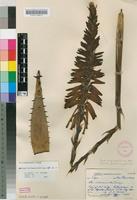
32. Aloe melanacantha A.Berger in Botan-ische Jahrbucher 36: 63 (1905a); A.Berger: 217 (1908); Pole Evans: t. 433 (1931a); Reynolds: 181 (1950); Jeppe: 25 (1969); Bornman & D.S.Hardy: 61 (1972); B.-E. van Wyk & G.F.Sm.: 148 (1996). Type: Northern Cape, near Garies, Drege 2697 (W).
Range
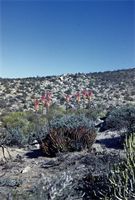
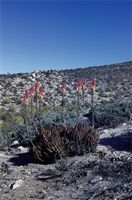
Occurring in the Northern and Western Cape, this species grows on rocky hillsides with little soil, in succulent karoo with winter rainfall. The record of A. melanacantha from Namibia quot­ed by Solch, Roessler & Merxmuller (1970: 17) is based on a misidentification; the plant referred to there is A. erinacea (no. 33). Map 25.

Related Materials

  • Terms and Conditions
  • Privacy Policy
  • Cookie Policy
  • Cookie Settings
  • Accessibility
  • Help
  • Contact Us
  • Facebook
  • Twitter
ITHAKA

JSTOR is part of ITHAKA, a not-for-profit organization helping the academic community use digital technologies to preserve the scholarly record and to advance research and teaching in sustainable ways.

©2000-2026 ITHAKA. All Rights Reserved. JSTOR®, the JSTOR logo, JPASS®, Aluka®, and ITHAKA® are registered trademarks of ITHAKA.

╳