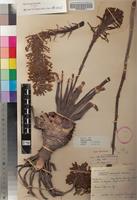
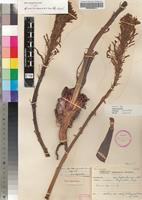
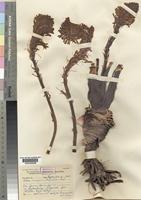
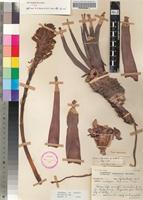
South African National Biodiversity Institute, Compton Herbarium, Cape Town (SAM)
Collection
Flora of Southern Africa
Resource Type
Reference Sources
Entry From
Flora of South Africa, (2003) Author: Dr J.P. Roux
Names
Aloe integra [family ALOACEAE]
Information
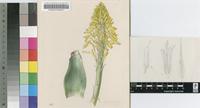
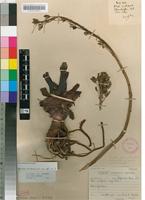
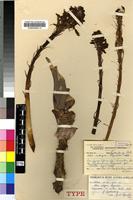
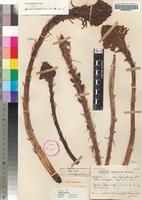
Stemless grass aloe 350-500 mm tall, solitary; roots fusiform. Leaves 15-30 in a rosette, lorate, 100-200(-500) x 20-50 mm, often with a short or long dried apex adhering, slightly canaliculate, margins cartilaginous, usually entire, rarely ciliate. Inflorescence a dense, cylindric-conical to capitate raceme; peduncle 350-700 mm long (including raceme), with sterile bracts; bracts narrowly deltoid-acumiÂnate, 12-25 x 4-6 mm, 5-7-nerved, purplish. Flowers lemon-yellow to canary-yellow, 13-27 mm long; segments free; pedicels 20-30 mm long, lengthening in fruit to 30^10 mm. Anthers exserted 1-3 mm. Ovary 5-7 x 2-3 mm, olive-green; style exserted 2-5 mm. Fruit 12-15 x 6-8 mm, pale grey. Flowering time October to December.
Habitat
The racemes of this species terminate in a small tuft of purple bracts, unlike any other species in this section. In general appearance this species is closest to A. ecklonis (no. 19), and when not in flower it may be distinguished from that species by the shorter leaves, of which the margins are entire or at most only minutely denticulate.
Use
18. Aloe integra Reynolds in The Flowering Plants of South Africa 16: t. 607 (1936c); Reynolds: 141 (1950); Jeppe: 131 (1969); Bornman & D.S.Hardy: 35 (1972); Compton: 100 (1976); B.-E. van Wyk & G.F.Sm.: 268 (1996). Type: Mpumalanga, Lydenburg District, Reynolds 1650 (PRE, holo.!; BOL!).
Range
Found in Mpumalanga and Swaziland. A. integra occurs in highveld grassland, usually on sandy, stony soil. Flowering seems to be stimuÂlated by fire. Map 12.