JSTOR Global Plants Home
  • Home
  • Browse
  • About
  • Access
  • Account
    • Saved Items
    • Profile
  • Log in

Global Plants

Skip to Main Content
  • JSTOR Global Plants Home
  • Global Plants

    • Browse
    • About
    • Access
    • Account
      • Saved Items
      • Profile
Log in
  • Browse
  • About
  • Access
  • Account
    • Saved Items
    • Profile
Advanced Search

Compilation
Aloe hardyi

2 Images see all

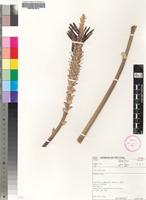
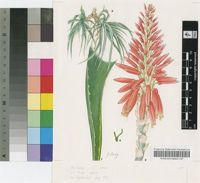
Holotype of Aloe hardyi Glen [family ASPHODELACEAE]
Aloe hardyi Glen
Previous
Next

Name

Identification
Aloe hardyi Glen [family ASPHODELACEAE ]
Related name
  • Aloe hardyi

Flora

Entry for Aloe hardyi [family ALOACEAE]
Herbarium
South African National Biodiversity Institute, Compton Herbarium, Cape Town (SAM)
Collection
Flora of Southern Africa
Resource Type
Reference Sources
Entry From
Flora of South Africa, (2003) Author: Dr J.P. Roux
Names
Aloe hardyi [family ALOACEAE]
Information
Plants pendent; stems up to ± 1.5 m long, rosettes 300-600 x 300-600 mm. Leaves some­times distichous, 12-20 per rosette, hanging, 400-700 x 50-80 mm, glaucous blue-green. Inflorescence a simple, subdense, conical to subcapitate raceme, 2 or 3 simultaneously, ± 250 mm long; peduncle with few truncate ster­ile bracts; bracts obovate-acute, 14-17 x 10-15 mm, many-nerved. Flowers pink to red, slight­ly trigonously indented, 25-35 mm long; pedicels 15-30 mm long. Anthers exserted up to 5 mm. Style exserted up to 8 mm. Flowering time June to August. Figure 18.
Habitat
This species is one of the most variable of the southern African representatives of the genus Aloe. It differs from A. pluridens (no. 97) in branching much more freely and in having broader, more glaucous green leaves. The racemes of A. arborescens are denser, broader and more obtuse than those of A. pluridens. A. hardyi (no. 95) is always pendent, whereas A. arborescens is seldom truly pendent with hang­ing leaves. In A. hardyi the raceme is only about half the length of that of A. arborescens and it is somewhat laxer. The pedicels and flowers are somewhat shorter, but the two species overlap in these characters. The two aloes most similar to this species are A. arborescens (no. 96) and the Angolan species A. mendesii. Differences between this species and A. arborescens are discussed under that species. A. mendesii is also a pendent species with hanging leaves and conical racemes, but it has much narrower bracts with only 5 nerves, shorter pedicels and flowers, and less exserted anthers and styles.
Use
95. Aloe hardyi Glen in The Flowering Plants of Africa 49: t. 1942 (1987); B.-E. van Wyk & G.F.Sm.: 82 (1996). Type: Mpumalanga, Lydenburg District, Fourie 3252 (PRE!).
Range
Aloe hardyi occurs in almost inaccessible places on cliffs on the escarpment in the Northern Province. Its exact range is not known because of the difficulty of approaching plants. It grows in the mist belt in an area of high summer rainfall, warm summers and cold winters. The area in which it occurs is notable for the high proportion of endemism in the local flora. Map 67.

Related Materials

  • Terms and Conditions
  • Privacy Policy
  • Cookie Policy
  • Cookie Settings
  • Accessibility
  • Help
  • Contact Us
  • Facebook
  • Twitter
ITHAKA

JSTOR is part of ITHAKA, a not-for-profit organization helping the academic community use digital technologies to preserve the scholarly record and to advance research and teaching in sustainable ways.

©2000-2026 ITHAKA. All Rights Reserved. JSTOR®, the JSTOR logo, JPASS®, Aluka®, and ITHAKA® are registered trademarks of ITHAKA.

╳