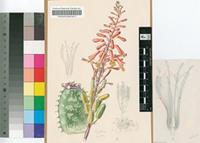
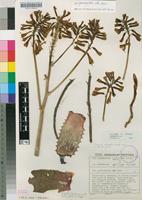
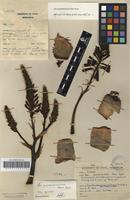
Entry for Aloe grandidentata Salm-Dyck [family ALOACEAE]
Herbarium
Royal Botanic Gardens, Kew (K)
Collection
Flora Capensis
Resource Type
Reference Sources
Entry From
Flora Capensis, page 253, (1897) Author: (By J. G. BAKER).
Names
Aloe grandidentataSalm-Dyck [family ALOACEAE], Hort. 329; Aloe, sect. xxiii. fig. 4;—Roem. et Schultes, Syst. Veg. vii. 699; Kunth, Enum. iv. 525; Baker in Journ. Linn. Soc. xviii. 166.
Information
stem 1/2–1 ft. long, simple, 2–2 1/2 in. diam. below the dense rosette of leaves; leaves 12–20, lanceolate, 1–1 1/2 ft. long, 2 1/2–3 in. broad in the lower half, narrowed gradually from the middle to the apex, 1/4 in. thick in the middle; face bright green with wavy transverse bands of oblong whitish spots; marginal teeth crowded, deltoid-cuspidate, brown-tipped, 1/4 in. long; peduncle robust, 1 1/2–2 ft. long; racemes 3–7, oblong, the end one 6–8 in. long; lower pedicels 1/2 in. long; bracts as long as the lower pedicels; perianth pale red or yellowish-red, 1–1 1/8 in. long; tube constricted above the ovary; segments as long as the tube; stamens about as long as the perianth. null
Distribution
SOUTH AFRICA without locality.
Notes
Introduced into cultivation about 1820. Both this and A. latifolia have been hybridized by Mr. Lynch with A. striata.