JSTOR Global Plants Home
  • Home
  • Browse
  • About
  • Access
  • Account
    • Saved Items
    • Profile
  • Log in

Global Plants

Skip to Main Content
  • JSTOR Global Plants Home
  • Global Plants

    • Browse
    • About
    • Access
    • Account
      • Saved Items
      • Profile
Log in
  • Browse
  • About
  • Access
  • Account
    • Saved Items
    • Profile
Advanced Search

Compilation
Aloe gariepensis

5 Images see all

Aloe gariepensis Pillans
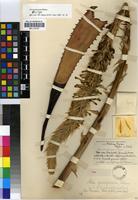
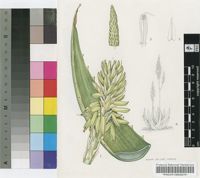
Holotype of Aloe gariepensis Pillans [family ASPHODELACEAE]
Aloe gariepensis Pillans
Previous
Next

Name

Identification
Aloe gariepensis Pillans [family ASPHODELACEAE ]
Related name
  • Aloe gariepensis

Flora

Entry for Aloe gariepensis [family ALOACEAE]
Herbarium
South African National Biodiversity Institute, Compton Herbarium, Cape Town (SAM)
Collection
Flora of Southern Africa
Resource Type
Reference Sources
Entry From
Flora of South Africa, (2003) Author: Dr J.P. Roux
Names
Aloe gariepensis [family ALOACEAE]
Common names
A. gariusana Dinter: 31 (1928) nom. nud.
Information
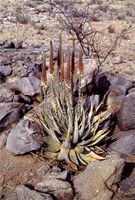
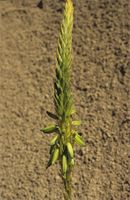
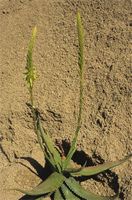
Plants usually solitary, stemless to short-stemmed, up to 1 m tall. Leaves many, lanceo­late to deltoid, arcuate-erect to arcuate-incurved, 250-500 x 50-90 mm, dull green to reddish brown, obscurely lined, with or without spots. Inflorescence a simple, very dense, cylindric to conical raceme, 3-5 simultaneously, 0.8-1.2 m tall; peduncle with many sterile bracts; bracts narrowly lanceolate-acuminate, 17-26 x 6-8 mm, 5-7-nerved. Flowers usually yellow, rarely brick-red, 16-27 mm long; pedicels 12-20 mm long, lengthening to ± 25 mm in fruit. Anthers exserted 1-5 mm. Ovary 4.0-5.0 x 1.5-2.0 mm, green; style exserted 3-6 mm. Fruit ± 14-16 x 8-9 mm, yellow-brown. Seeds ±5x2x1 mm, black with pale trans­verse wings at each end. Flowering time July to September. Figure 17.
Habitat
Aloe gariepensis is the only species in this section in which the flowers are usually yellow both in bud and at flowering. Plants are usually solitary, unlike the much-branched, shrubby A. succotrina (no. 91), and the leaf sap does not dry purple, with the result that dried leaves are not this colour. The leaves of A. gariepensis are lined, and may be spotted or unspotted. The eastern form of this species is much more robust than the type.
Use
93. Aloe gariepensis Pillans in South African Gardening and Country Life 23: 213 (1933a); Reynolds: 400 (1950); Jeppe: 32 (1969); Soldi, Roessler & Merxm.: 16 (1970); Bornman & D.S.Hardy: 217 (1972); I.Verd.: t. 1654 (1972); Jankowitz: 28 (1975); B.-E. van Wyk & G.F.Sm.: 172 (1996). Type: Namibia, near Warmbad, Pillans 6557 (BOL!).
Range
This species is found in Namibia and the Northern Cape. Typically it grows in rock cracks on steep slopes close to the Orange River in the driest part of its course. In some localities it occurs in small pockets of sandy soil on rocky outcrops. Map 65.

Related Materials

  • Terms and Conditions
  • Privacy Policy
  • Cookie Policy
  • Cookie Settings
  • Accessibility
  • Help
  • Contact Us
  • Facebook
  • Twitter
ITHAKA

JSTOR is part of ITHAKA, a not-for-profit organization helping the academic community use digital technologies to preserve the scholarly record and to advance research and teaching in sustainable ways.

©2000-2026 ITHAKA. All Rights Reserved. JSTOR®, the JSTOR logo, JPASS®, Aluka®, and ITHAKA® are registered trademarks of ITHAKA.

╳