JSTOR Global Plants Home
  • Home
  • Browse
  • About
  • Access
  • Account
    • Saved Items
    • Profile
  • Log in

Global Plants

Skip to Main Content
  • JSTOR Global Plants Home
  • Global Plants

    • Browse
    • About
    • Access
    • Account
      • Saved Items
      • Profile
Log in
  • Browse
  • About
  • Access
  • Account
    • Saved Items
    • Profile
Advanced Search

Compilation
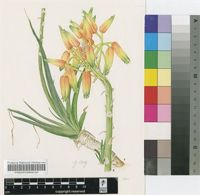
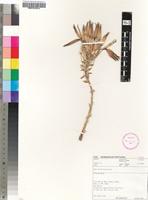
Aloe fouriei

2 Images see all

Aloe fouriei D.S.Hardy & Glen
Holotype of Aloe fouriei D.S.Hardy & Glen [family ASPHODELACEAE]
Previous
Next

Name

Identification
Aloe fouriei D.S.Hardy & Glen [family ASPHODELACEAE ]
Related name
  • Aloe fouriei

Flora

Entry for Aloe fouriei [family ALOACEAE]
Herbarium
South African National Biodiversity Institute, Compton Herbarium, Cape Town (SAM)
Collection
Flora of Southern Africa
Resource Type
Reference Sources
Entry From
Flora of South Africa, (2003) Author: Dr J.P. Roux
Names
Aloe fouriei [family ALOACEAE]
Information
Short-stemmed grass aloe, solitary or form­ing small clumps; stems ±150 mm tall, with old leaf bases adhering in apical ±100 mm. Leaves distichous, 275-350 x 10-25 mm, canaliculate, not keeled, grass-green, margins armed with teeth ± 0.4 mm long, 0.6 mm wide and 2.5 mm apart; old leaves dying back with persistent dead apices, and with white spots on abaxial surfaces. Inflorescence a subdense, capitate raceme of ± 20 flowers; peduncle ± 400 mm long, with ovate-acute sterile bracts; floriferous bracts with many nerves, ±16x8 mm. Flowers 35-40 mm long, 11-13 mm in diameter at base, 6-8 mm at mouth; all segments free to base, outer segments orange with green apices, inner segments yellow with green apices; pedicels pale green, 23-45 mm long, lengthening in fruit. Anthers included. Style included.
Habitat
The only other southern African species with any marked similarity to A. fouriei is A. cooperi (no. 21), a stemless species in which the leaves are keeled, the bracts are smaller than in our species and the pedicels are the same colour as the flower, not pale green like the upper pedun­cle as in our species. The caulescent habit and subcapitate racemes of this species serve to dis­tinguish it from other members of section Leptoaloe. The perianth segments are thick and fleshy, and so the sutures between the outer seg­ments appear as channels in the unopened buds as well as in the mature flowers. The flower is distinctly trigonous, a character unusual in this section.
Use
15. Aloe fouriei D.S.Hardy & Glen in The Flowering Plants of Africa 49: t. 1941 (1987); B.-E. van Wyk & G.F.Sm.: 262 (1996). Type: Mpumalanga, Pilgrims Rest District, Fourie 3070 (PRE!).
Range
Occurring in montane grassland of the Northern Province and Mpumalanga. Aloe fouriei favours steep slopes of southeastern aspect in grassland in dolomitic crevices. In such places, it may grow with stems erect to oblique. Map 11.

Related Materials

  • Terms and Conditions
  • Privacy Policy
  • Cookie Policy
  • Cookie Settings
  • Accessibility
  • Help
  • Contact Us
  • Facebook
  • Twitter
ITHAKA

JSTOR is part of ITHAKA, a not-for-profit organization helping the academic community use digital technologies to preserve the scholarly record and to advance research and teaching in sustainable ways.

©2000-2026 ITHAKA. All Rights Reserved. JSTOR®, the JSTOR logo, JPASS®, Aluka®, and ITHAKA® are registered trademarks of ITHAKA.

╳